Well, it’s official: I am now a bona fide fugitive of the law.
Yeah, ‘member the little palm-greasing stunt we pulled at the airport to secure me my three-year visa? ‘Member our winking we-just-worked-the-system glee? Well, turns out our elation was a bit premature. Actually, it turns out we’re just a bunch of idiots. Because – it turns out – my “three-year, multiple entry visa” requires revalidation/renewal every 30 days. Says so, right there on the blinkin’ stamp: V30D.
As if any of us knew what “V30D” meant.
As if any of us even looked.
Anyhoo, yeah. So I’m now here in Zambia illegally, which means – at the advice of the American consulate – I’m “laying low” for the moment and waiting for a letter from AIDSRelief vouching for my status as a volunteer and keeping my fingers crossed that the emissary they send to Immigration on my behalf is successful. I can’t go myself because, as the nice lady behind the plate glass window at the consulate said, “Yeah, I’m not saying for sure this would happen? But if you show up to pay the fine yourself, there’s a really good chance they’ll throw you in jail and send you home.”
Awesome.
Ooh, but on the plus side, I got braids!
Monday, March 19, 2007


I want to be a kid again. Or maybe I just want to be Irish.
I rarely lament the passing of birthdays – which is not to say that I don’t vigilantly (vainly?) catalog every odd gray hair that sprouts unbidden from my crown – but I’ve never been one  consumed with dreams of revisiting a halcyon youth. Not that I had an unhappy childhood – I’d be an a**hole to suggest I did – but I did have a lonely one. An (unwittingly) self-imposed lonely one, to be sure, but a lonely one – borne of a purely-intended but ultimately misguided self-righteousness and shallow piety that I believed might spare me the potential dreaded burden of disappointing God or my family or my church but which only served to make me the proverbial, pinched killjoy, an unlikely candidate for friendship. So a tourist, I was. A visitor. But never an inhabitant of the insular worlds orbiting around me. I hovered on the fringes, desperate to belong, but fear (and back then, too often, judgment) kept me hostage to my own isolation. (I am still plagued, to a certain extent, with the vestiges of this interior covenant, for I often find that even my most cherished friends belong already to their own, well-established communities – their own, insular worlds – and by their grace I trespass from time to time, but never quite find my home among them; no self-righteous judgment now, but the fear remains…of rejection? of revealing my true self? I don’t know…). Anyhoo, so yeah – I’ve always been quite determined to leave that particular ghost behind and will routinely dispense with any affiliated memories with eager, if sometimes wanton, abandon (in my haste to cast off my most forlorn recollections, I’m sure I’ve misplaced a few of the good ones as well, else how do I explain finding, in an otherwise pretty good life, such grist for the poor-me mill?).
But then I met the “Irish” (what they’re affectionately called here at St. Francis), a family of short-term volunteers at the hospital, and I was startled by an unexpected envy and a sharp, if unfamiliar, longing for youth. As a family, they utterly captivated me. Both the parents - aging hippy-type doctors afflicted with an incurable wanderlust - but especially the children. First seven year-old V, a round-faced, smiling Thai boy the family adopted a few years ago, who spent most of his days at the house where I’m staying in happy collusion with Shelagh’s three youngest kids; and ten year-old Lili, a bold, feisty, fearless, slip of a girl (a “pistol”, my dad would call her), whip-smart and bright with spirit. Then Freya – elegant, willowy, lovely, grounded Freya – who, at twelve years old, already possesses more grace and poise than I could hope to in my lifetime. And, finally, eldest son Patrick. I’ve yet to meet the rakish doctor that all my friends are convinced I will on my little adventure – and for whom I keep my fingers firmly and optimistically crossed – but if I can wait 15 or 20 years, I think I might know where to find him. Youthful swagger, mischievous grin, disarming Irish charm, way too smart for his own good… Oh to be sixteen again, with the world quite literally my playground and no years of accumulated sorrows (thank you, Julia Glass) to shed.
I don’t know. Maybe I’m romanticizing these kids. Maybe they roll their eyes and harbor secret resentment at the announcement of each new family adventure; maybe, in true shortsighted adolescent fashion, they have no idea how lucky they are – shuttled periodically as they are from one exotic country to another – and instead find that their peripatetic life leaves them feeling as hopelessly unanchored and unmoored as I do (I wonder if, when you make the world your home, you might sometimes feel as though you have no home at all…?). Maybe this constant motion has made them miserable outcasts in Dublin and they suffer the same loneliness I do, the same yearning to belong – somewhere, anywhere. I don’t know - I didn’t ask - but I doubt it. These kids are too bold, too self-assured, too together. In short, they’re way too cool. And I can’t help but find myself wishing for a chance at life the way they know it.
*****
So I’m at St. Francis now. Er, well, I was when I started writing this entry (man, I suck at blogging!). Anxious to get back out to the rural areas, I jumped at Shelagh’s invitation to accompany her family back to Katete and piled myself in to the Land Cruiser alongside the three remaining children, Shelagh, Sam, Ian, two new VSO (the British equivalent to the Peace Corps) volunteers, and all of the family’s accumulated chattel. Chiko and Jim slept on stacked foam mattresses for most of the ride, a tangle of bony elbows and knees and Calvin-and-Hobbes feet, their pale English skin – remarkably untouched by the harsh African sun – peeking out from beneath sundresses and shorts. Josh, poor wee one, sat in mum’s lap for the ride, projectile vomiting when he wasn’t crying out in pain (he did, in the end, get himself in to quite a fix with all his exploring – climbed up in to the bidet in the master bathroom while mom was in the shower and turned on the hot tap, sustaining second-degree burns when he couldn’t get himself out and she couldn’t get to him fast enough).
There were no vacancies at any of the guest houses so I’m staying with Shelagh and the family, amidst all the organized chaos, working at the dining room table or on the bed under the mosquito net in eldest daughter Amy’s room, analyzing the multiple data capture systems the hospital has and trying to figure out if there’s a way to get them all talking to each other. It’s fun. Er, mostly... As much fun as one can have with three (sometimes four, when V comes around) screaming children running around and Love Actually playing on continuous loop, at full volume, over and over and over. (Seriously – we watched it three times in a row on Friday. In a row.) Not that I don’t enjoy Love Actually - it is, in fact, one of my favorite films - but you try watching it that many times and see if you still like it.
Besides which, it mocks me, this film (why couldn’t they have watched, say, The Lord of the Rings or Bob the Builder on repeat? oh wait a minute, no – they did…). Mocks my lamentable, perpetual singleness. If only because, for the moment (a very long moment, it feels like), I long for nothing so much as someone who will set my own heart aflame and turn up on my doorstep on Christmas (or Easter or Flag Day or, I don’t know, yesterday) with placards vowing that he’ll love me until I’m long past dead and gone.
Not that that’s why I came to Africa. In fact, I came to Africa - among a few other, ostensibly nobler reasons - for precisely the opposite. I came, at least in part, to put to rest the interminable post-heartbreak navel-gazing at which I’m so masterfully, distressingly practiced; to start living life instead of waiting for it to happen to me; to look outward instead of in; to – if I may be so bold – get the f*ck out of my own way. I expected I’d be too busy, too knee-deeply buried in the proverbial salt-mines to worry about such frivolity. But, as my last post pointed out, if there’s one thing I (unexpectedly) seem to have here, it’s heaps and heaps of time. So – apparently – here I go again.
I suppose, though, when there is one thing for which you long, one fundamental ache that gnaws at you, some itch you need scratched – whether it’s for love or friendship or community or to collect the complete set of first edition Marvel Comics – and you can’t quite seem wrap your fingers around it, it doesn’t matter how far or fast you run because – what’s that saying? – wherever you go, there you are. And every film you watch, every song you hear, every book you read will remind you of its absence.
Which brings me to Three Junes. I have never – if you can indulge my hyperbole for a moment – had a book so precisely write the landscape of my own bruised heart, its certain fingers deftly, gently pressing those bruises and bringing in to painfully tender relief my own accumulated sorrows (if not specifically in deed than certainly in sentiment). Exquisitely crafted, delicately but unflinchingly honest, it haunts the hollows of my heart, sparks new motivation, resurrects old longings – in short, it is the book I have always wanted to write. I cried for most of the last third (the final, eponymous June), and then for a good 45 minutes after I finally turned the last page and hucked it across the room in a fit of childish self-pity.
And so it goes, my journey. Expected and unexpected, high and low, everything new and old and new again.
Picture 1: V
Picture 2: Chiko (and parts of Jim) in the Land Cruiser
Picture 3: The "Irish" (sans V, who's hiding behind Lili) and friends
Picture 4: Herd of oxen near the St. Francis market
 consumed with dreams of revisiting a halcyon youth. Not that I had an unhappy childhood – I’d be an a**hole to suggest I did – but I did have a lonely one. An (unwittingly) self-imposed lonely one, to be sure, but a lonely one – borne of a purely-intended but ultimately misguided self-righteousness and shallow piety that I believed might spare me the potential dreaded burden of disappointing God or my family or my church but which only served to make me the proverbial, pinched killjoy, an unlikely candidate for friendship. So a tourist, I was. A visitor. But never an inhabitant of the insular worlds orbiting around me. I hovered on the fringes, desperate to belong, but fear (and back then, too often, judgment) kept me hostage to my own isolation. (I am still plagued, to a certain extent, with the vestiges of this interior covenant, for I often find that even my most cherished friends belong already to their own, well-established communities – their own, insular worlds – and by their grace I trespass from time to time, but never quite find my home among them; no self-righteous judgment now, but the fear remains…of rejection? of revealing my true self? I don’t know…). Anyhoo, so yeah – I’ve always been quite determined to leave that particular ghost behind and will routinely dispense with any affiliated memories with eager, if sometimes wanton, abandon (in my haste to cast off my most forlorn recollections, I’m sure I’ve misplaced a few of the good ones as well, else how do I explain finding, in an otherwise pretty good life, such grist for the poor-me mill?).
But then I met the “Irish” (what they’re affectionately called here at St. Francis), a family of short-term volunteers at the hospital, and I was startled by an unexpected envy and a sharp, if unfamiliar, longing for youth. As a family, they utterly captivated me. Both the parents - aging hippy-type doctors afflicted with an incurable wanderlust - but especially the children. First seven year-old V, a round-faced, smiling Thai boy the family adopted a few years ago, who spent most of his days at the house where I’m staying in happy collusion with Shelagh’s three youngest kids; and ten year-old Lili, a bold, feisty, fearless, slip of a girl (a “pistol”, my dad would call her), whip-smart and bright with spirit. Then Freya – elegant, willowy, lovely, grounded Freya – who, at twelve years old, already possesses more grace and poise than I could hope to in my lifetime. And, finally, eldest son Patrick. I’ve yet to meet the rakish doctor that all
 my friends are convinced I will on my little adventure – and for whom I keep my fingers firmly and optimistically crossed – but if I can wait 15 or 20 years, I think I might know where to find him. Youthful swagger, mischievous grin, disarming Irish charm, way too smart for his own good… Oh to be sixteen again, with the world quite literally my playground and no years of accumulated sorrows (thank you, Julia Glass) to shed.
I don’t know. Maybe I’m romanticizing these kids. Maybe they roll their eyes and harbor secret resentment at the announcement of each new family adventure; maybe, in true shortsighted adolescent fashion, they have no idea how lucky they are – shuttled periodically as they are from one exotic country to another – and instead find that their peripatetic life leaves them feeling as hopelessly unanchored and unmoored as I do (I wonder if, when you make the world your home, you might sometimes feel as though you have no home at all…?). Maybe this constant motion has made them miserable outcasts in Dublin and they suffer the same loneliness I do, the same yearning to belong – somewhere, anywhere. I don’t know - I didn’t ask - but I doubt it. These kids are too bold, too self-assured, too together. In short, they’re way too cool. And I can’t help but find myself wishing for a chance at life the way they know it.
*****
So I’m at St. Francis now. Er, well, I was when I started writing this entry (man, I suck at
 blogging!). Anxious to get back out to the rural areas, I jumped at Shelagh’s invitation to accompany her family back to Katete and piled myself in to the Land Cruiser alongside the three remaining children, Shelagh, Sam, Ian, two new VSO (the British equivalent to the Peace Corps) volunteers, and all of the family’s accumulated chattel. Chiko and Jim slept on stacked foam mattresses for most of the ride, a tangle of bony elbows and knees and Calvin-and-Hobbes feet, their pale English skin – remarkably untouched by the harsh African sun – peeking out from beneath sundresses and shorts. Josh, poor wee one, sat in mum’s lap for the ride, projectile vomiting when he wasn’t crying out in pain (he did, in the end, get himself in to quite a fix with all his exploring – climbed up in to the bidet in the master bathroom while mom was in the shower and turned on the hot tap, sustaining second-degree burns when he couldn’t get himself out and she couldn’t get to him fast enough).
There were no vacancies at any of the guest houses so I’m staying with Shelagh and the family, amidst all the organized chaos, working at the dining room table or on the bed under the mosquito net in eldest daughter Amy’s room, analyzing the multiple data capture systems the hospital has and trying to figure out if there’s a way to get them all talking to each other. It’s fun. Er, mostly... As much fun as one can have with three (sometimes four, when V comes around) screaming children running around and Love Actually playing on continuous loop, at full volume, over and over and over. (Seriously – we watched it three times in a row on Friday. In a row.) Not that I don’t enjoy Love Actually - it is, in fact, one of my favorite films - but you try watching it that many times and see if you still like it.
Besides which, it mocks me, this film (why couldn’t they have watched, say, The Lord of the Rings or Bob the Builder on repeat? oh wait a minute, no – they did…). Mocks my lamentable, perpetual singleness. If only because, for the moment (a very long moment, it feels like), I long for nothing so much as someone who will set my own heart aflame and turn up on my doorstep on Christmas (or Easter or Flag Day or, I don’t know, yesterday) with placards vowing that he’ll love me until I’m long past dead and gone.
Not that that’s why I came to Africa. In fact, I came to Africa - among a few other, ostensibly nobler reasons - for precisely the opposite. I came, at least in part, to put to rest the interminable post-heartbreak navel-gazing at which I’m so masterfully, distressingly practiced; to start living life instead of waiting for it to happen to me; to look outward instead of in; to – if I may be so bold – get the f*ck out of my own way. I expected I’d be too busy, too knee-deeply buried in the proverbial salt-mines to worry about such frivolity. But, as my last post pointed out, if there’s one thing I (unexpectedly) seem to have here, it’s heaps and heaps of time. So – apparently – here I go again.
I suppose, though, when there is one thing for which you long, one fundamental ache that gnaws at you, some itch you need scratched – whether it’s for love or friendship or community or to collect the complete set of first edition Marvel Comics – and you can’t quite seem wrap your fingers around it, it doesn’t matter how far or fast you run because – what’s that saying? – wherever you go, there you are. And every film you watch, every song you hear, every book you read will remind you of its absence.
Which brings me to Three Junes. I have never – if you can indulge my hyperbole for a moment – had a book so precisely write the landscape of my own bruised heart, its certain fingers
 deftly, gently pressing those bruises and bringing in to painfully tender relief my own accumulated sorrows (if not specifically in deed than certainly in sentiment). Exquisitely crafted, delicately but unflinchingly honest, it haunts the hollows of my heart, sparks new motivation, resurrects old longings – in short, it is the book I have always wanted to write. I cried for most of the last third (the final, eponymous June), and then for a good 45 minutes after I finally turned the last page and hucked it across the room in a fit of childish self-pity.
And so it goes, my journey. Expected and unexpected, high and low, everything new and old and new again.
Picture 1: V
Picture 2: Chiko (and parts of Jim) in the Land Cruiser
Picture 3: The "Irish" (sans V, who's hiding behind Lili) and friends
Picture 4: Herd of oxen near the St. Francis market
The bloom is off the rose (or, Lusaka Sucks)
I am in the kitchen, kneading dough for bread, and dodging baby Joshua as he totters determinedly from corner to corner, exploring every perilous-for-two-year-olds inch of his new playground. It’s been raining for most of the day and I’ve spent it holed up in the IHV house waiting for our houseguests, whom I expected around two but who did not arrive until half past six. The house, abruptly silent in the wake of Sanjiv’s mid-morning departure (he was the last of the IHV team to depart for the US for CROI, an annual international HIV/AIDS conference,  leaving me to fend for myself for two weeks in Lusaka) now echoes with the busy chatter of the nine people who’ve descended upon it: mom Shelagh (executive director of St. Francis Mission Hospital in Katete), dad Ian, six (six!) kids, and cousin Sam from Australia. They’ve come to Lusaka to shuttle the eldest three off to boarding school and attend to the various hospital and personal business that they are unable to while out in the rural village they call home.
A cheerful if weary bunch, they file in singly, flushed and sticky from the long, bumpy ride up from Katete, matted hair pressed to damp cheeks. First four-year-old Chiko (her place in this familial queue just the first evidence of who’s running this show); then Jim; then Kate, Jack, and Amy; then Ian and Sam; and, finally, Shelagh – bright cornflower eyes twinkling behind small wire frames, worn, dirt-smudged cargo pants hanging loosely on her hips (FUBU, funnily enough, but don’t mistake this brand choice for a finger-on-the-pulse-of-urban-fashion sentiment; these were likely scavenged from some mission donation box) – juggling Joshua and a bottle of wine in her arms. “Well, then. Thanks for havin’ us,” she says in a thin, bird-like English cockney. She thrusts the bottle of wine unceremoniously into my hands and moves past me in to the kitchen to corral her brood.
“Sure, it’s…” no problem, I finish in my head, trailing after her. Already the TV is on and tuned to the Cartoon Network, Chiko has changed from her sundress into her princess gown and scattered her toys, and Josh has begun his exploring, tiny fingers searching, opening, shutting, narrowly escaping certain mangling. Clearly, we are dispensing with any further formalities, so I head over to the counter, sink my fingers back in to the soft yeasty ball and continue kneading.
“S’how long have you been in Zambia?” Shelagh asks me, as she deftly – and simultaneously – unwraps a candy bar for Joshua, pours six-year-old Jim juice and enthusiastically lauds Chiko’s assembly of a jigsaw puzzle like it’s a newly discovered Klimt.
“I, um - ,” I stammer, swiping flour from my nose and blowing an errant tendril of hair from my face. Shelagh could successfully launch the next space shuttle mission whilst simultaneously reading her children Alice in Wonderland and performing a cesarean, but I apparently still struggle to master tasks of the chew-gum-and-walk ilk. “Six, er, I mean – uh, actually, about two months now,” I say and nearly trample Josh underfoot.
“Right. Yeah, ok,” she nods. “And what sort of work have you been doin’ since you got here?”
“Well, I was lucky enough to spend my first month out at a couple rural sites, doing some work with the data capture folks at each place,” I tell her. “We were at Chilonga and Mukinge for two weeks each. And I’ve been to Mwandi as well, but that was a couple weeks ago and only for three days. Unfortunately,” and here an involuntary sigh, “I’ve been stuck in Lusaka for pretty much the last month.”
“Ech,” Shelagh spits, her blue eyes darkening. “Lusaka’s a dump.”
Well. I’m just glad she said it.
Not that she’s exactly right. And not that I blame the capital city entirely, but my second month in Zambia has been markedly different from my first. With the exception, as I mentioned to Shelagh, of one three-day foray to Mwandi Mission Hospital to aid with a follow-up site assessment (formerly an independently-supported mission hospital, Mwandi will now be under the purview of the AIDSRelief consortium; consequently, it will both benefit from its considerable resources – AIDSRelief is supported by a multi-kajillion dollar PEPFAR grant – and suffer from the maddening red tape and bureaucracy that bind it; eh, you gotta give a little to get a little, I guess), I’ve been here in Lusaka. As the title for this entry intimates, I don’t so much care for it.
I recently tried, quite unsuccessfully, to describe for my mother what Lusaka was “like.” In some ways, it feels much like any American city – except of course that everyone is black and poor. A study in contradictions, it is highly developed – there’s public transportation, strip malls, satellite TV, and wireless communication towers soar above the flush, rainy-season-green flora – but (it seems) it’s been so rapidly developed that it lacks the sort of stable infrastructure necessary to keep such developments running smoothly – or often even running at all (like, for one tiny example, our wireless internet, which has been quite temperamental as of late). But then, when you foist the latest technological advancements on a people disinclined to change – and do it without providing for a more measured, gradual evolution – you might expect a certain stumbling, cart-before-the-horse condition.
And it’s difficult to reconcile the image of a sleek black Beemer or Mercedes rolling down Sable Road (our street) past the young shirtless boy in tattered, mud-spattered Bermudas and sneakers with no laces and soles worn so thin you wonder why he even bothers with shoes. Especially when you know the Mercedes will no doubt turn in to one of the gated, guarded drives on Sable, the yawning black tarmac neatly rending lush, manicured lawns and rich gardens, while the little boy will proceed, scarcely another 300 meters, to the crowded cinderblock shantytown up ahead – rutted, garbage-strewn dirt pathways a map to a decidedly less felicitous life. His mother will likely own a cell phone, though, and his family’s tiny, rectangular hut might even boast a giant satellite dish, looming like a watchful eye. But those shoes are probably his only pair and, outside of his school uniform, the shorts may be as well. It’s especially difficult when you realize that these disparate conditions are drawn – with exceptions, to be sure, but alarmingly few – almost exclusively along racial lines, evidence for a not-so-thinly disguised neo-colonialism.
I don’t know. Such observations tell only part of the story: only part of Lusaka’s, because I know I haven’t been here long enough, haven’t witnessed enough, to truly understand or speak with any authority (real or of my own invention) on the economic, cultural and social ideologies and practices that form the city; and only part of mine, because – as with any craven impulse to complain – my feelings about Lusaka have very little to do with external factors and infinitely more to do with me, and the expectations I had for what I thought it would be like here. And what I expected was, well, I don’t know exactly… I guess I assumed I’d swoop in all eager and enthusiastic like, welcomed with open, grateful arms by the small corps of development workers stretched thin by all their do-gooder-ness and be put to immediate, fulfilling, tangible-results work.
How naïve. How (wince) vain.
There’s just – ok, here’s where I surrender to the craven impulse – there’s nothing to do in Lusaka. It may offer all of the conveniences of a developed city but, without work – and, at the moment, there’s none for me here – there's little else to fill the time that those conveniences save. And there, my friends, is the rub. (I swear, I don’t suffer this angst, this ennui, when I am out at the sites – out there, there’s not only plenty of work, but – as earlier posts attest – there’s plenty of living). There are no parks or theatres or museums (actually, I think there might be one small museum) and the Kabwata “cultural village”, billed as a carefully preserved slice of authentic Zambian cultural life, is really more a scaled-down street bazaar, a place to buy curios and trinkets ostensibly hand-crafted by local artisans but which are, in reality, largely mass-produced and shipped in from Tanzania or Kenya. There’s not even the distraction of a three-hour load of laundry to occupy me because Virginia (the housekeeper we’ve been told we should hire because it’s good for the economy because hiring house-help creates jobs but who, consequently, honestly believes that white people don’t know how to launder clothes or wash dishes or scrub floors) does it for us.
In other words, I’m bored. Bored as a board, my best friend might say. (Hi La!) A discomfiting feeling because, after all, I came here to be of use; because – I told everyone – I came here to serve. I never expected I’d feel so unpurposed, so…aimless. I never expected I’d feel so dependent, or so like a captive to the demands life and work have placed on those who might otherwise free me: Chris and Amy (who might take me with them to another site) are back in the States (or they were when I started writing this); Nawa (who might give me a job) has a meeting with his U.S.-based team in Tanzania; Megan (who might show me around town) has a kid…
So (don’t laugh) I started baking bread. A lot of bread. And I started experimenting with dinner recipes. And I went to the cultural village at Kabwata anyway, and browsed the “authentic” curios (and found that, actually, many of them are - the copper pieces, amatite, and Mukwa carvings at least…), and visited the agricultural fairgrounds. I started taking the minibuses around (the public transportation “system”, though I use the term loosely); learned how to drive on the left side of the road with BAVs (Chris and Amy’s Big Ass Vehicle); and did a game ride on horseback at Lilayi, a small game farm about 25 minutes outside of the city, where I saw wildebeest and impala and zebra and a tiny baby giraffe out for a walk with its whole family. Alas, none of my pics came out, but did I mention I was on horseback when I saw them?!?!
And I walk. All around the city. For hours at a time. And though my walks often leave me feeling vaguely queasy (air pollution is a huge problem in Lusaka) they always lift my spirits. Zambians are, without question, the warmest, friendliest people I’ve ever encountered. No matter the burdens they may be carrying, no matter the baggage (literal or figurative), no matter how tired they might be or how focused on getting home, whoever I meet on my walks always greets me with a wide, easy smile and a kind word. They are also, for reasons unknown to me, endlessly amused by the sight of a muzungu exercising. Especially the children, who – giggling madly – will ape my swinging arms, my wiggling hips, in comic exaggeration of my walk; or race me when I’m jogging. Although, I should point out, the racing is not exclusive to children. Once, while running through Kalingalinga, a sort of shantytown bordering my neighborhood, a man fell in step with me, cigarette in his hand, house slippers flapping on his feet.
“Mah-dahm!” he shouts, gamely trotting alongside me. “You are exercising?”
“I am,” I say, stifling a giggle.
“I will go with you!” he yells and the people on the street begin cheering us on, clapping and waving their arms. “You are going a long time?” he asks, after about a quarter of a mile.
“Oh, a bit longer,” I say, and gesture distantly towards the end of the road. “Maybe another thirty minutes. Maybe forty-five.”
“Ah. Ok,” he huffs and slows. “I will just go with you tomorrow.”
I also accepted Shelagh’s invitation to accompany her family back to St. Francis for a week, or ten days, or however long it will take me to assess their data issues and determine whether or not I can help. I have no idea if I’ll even be able to but, for the moment, I am glad for the opportunity to escape.
Picture 1: Kabwata Cultural village
Picture 2: The Gardens at the agricultural fairgrounds
Picture 3: A (dead, poor thing) butterfly I encountered on one of my walks
 leaving me to fend for myself for two weeks in Lusaka) now echoes with the busy chatter of the nine people who’ve descended upon it: mom Shelagh (executive director of St. Francis Mission Hospital in Katete), dad Ian, six (six!) kids, and cousin Sam from Australia. They’ve come to Lusaka to shuttle the eldest three off to boarding school and attend to the various hospital and personal business that they are unable to while out in the rural village they call home.
A cheerful if weary bunch, they file in singly, flushed and sticky from the long, bumpy ride up from Katete, matted hair pressed to damp cheeks. First four-year-old Chiko (her place in this familial queue just the first evidence of who’s running this show); then Jim; then Kate, Jack, and Amy; then Ian and Sam; and, finally, Shelagh – bright cornflower eyes twinkling behind small wire frames, worn, dirt-smudged cargo pants hanging loosely on her hips (FUBU, funnily enough, but don’t mistake this brand choice for a finger-on-the-pulse-of-urban-fashion sentiment; these were likely scavenged from some mission donation box) – juggling Joshua and a bottle of wine in her arms. “Well, then. Thanks for havin’ us,” she says in a thin, bird-like English cockney. She thrusts the bottle of wine unceremoniously into my hands and moves past me in to the kitchen to corral her brood.
“Sure, it’s…” no problem, I finish in my head, trailing after her. Already the TV is on and tuned to the Cartoon Network, Chiko has changed from her sundress into her princess gown and scattered her toys, and Josh has begun his exploring, tiny fingers searching, opening, shutting, narrowly escaping certain mangling. Clearly, we are dispensing with any further formalities, so I head over to the counter, sink my fingers back in to the soft yeasty ball and continue kneading.
“S’how long have you been in Zambia?” Shelagh asks me, as she deftly – and simultaneously – unwraps a candy bar for Joshua, pours six-year-old Jim juice and enthusiastically lauds Chiko’s assembly of a jigsaw puzzle like it’s a newly discovered Klimt.
“I, um - ,” I stammer, swiping flour from my nose and blowing an errant tendril of hair from my face. Shelagh could successfully launch the next space shuttle mission whilst simultaneously reading her children Alice in Wonderland and performing a cesarean, but I apparently still struggle to master tasks of the chew-gum-and-walk ilk. “Six, er, I mean – uh, actually, about two months now,” I say and nearly trample Josh underfoot.
“Right. Yeah, ok,” she nods. “And what sort of work have you been doin’ since you got here?”
“Well, I was lucky enough to spend my first month out at a couple rural sites, doing some work with the data capture folks at each place,” I tell her. “We were at Chilonga and Mukinge for two weeks each. And I’ve been to Mwandi as well, but that was a couple weeks ago and only for three days. Unfortunately,” and here an involuntary sigh, “I’ve been stuck in Lusaka for pretty much the last month.”
“Ech,” Shelagh spits, her blue eyes darkening. “Lusaka’s a dump.”
Well. I’m just glad she said it.
Not that she’s exactly right. And not that I blame the capital city entirely, but my second month in Zambia has been markedly different from my first. With the exception, as I mentioned to Shelagh, of one three-day foray to Mwandi Mission Hospital to aid with a follow-up site assessment (formerly an independently-supported mission hospital, Mwandi will now be under the purview of the AIDSRelief consortium; consequently, it will both benefit from its considerable resources – AIDSRelief is supported by a multi-kajillion dollar PEPFAR grant – and suffer from the maddening red tape and bureaucracy that bind it; eh, you gotta give a little to get a little, I guess), I’ve been here in Lusaka. As the title for this entry intimates, I don’t so much care for it.
I recently tried, quite unsuccessfully, to describe for my mother what Lusaka was “like.” In some ways, it feels much like any American city – except of course that everyone is black and poor. A study in contradictions, it is highly developed – there’s public transportation, strip malls, satellite TV, and wireless communication towers soar above the flush, rainy-season-green flora – but (it seems) it’s been so rapidly developed that it lacks the sort of stable infrastructure necessary to keep such developments running smoothly – or often even running at all (like, for one tiny example, our wireless internet, which has been quite temperamental as of late). But then, when you foist the latest technological advancements on a people disinclined to change – and do it without providing for a more measured, gradual evolution – you might expect a certain stumbling, cart-before-the-horse condition.
And it’s difficult to reconcile the image of a sleek black Beemer or Mercedes rolling down Sable Road (our street) past the young shirtless boy in tattered, mud-spattered Bermudas and sneakers with no laces and soles worn so thin you wonder why he even bothers with shoes. Especially when you know the Mercedes will no doubt turn in to one of the gated, guarded drives on Sable, the yawning black tarmac neatly rending lush, manicured lawns and rich gardens, while the little boy will proceed, scarcely another 300 meters, to the crowded cinderblock shantytown up ahead – rutted, garbage-strewn dirt pathways a map to a decidedly less felicitous life. His mother will likely own a cell phone, though, and his family’s tiny, rectangular hut might even boast a giant satellite dish, looming like a watchful eye. But those shoes are probably his only pair and, outside of his school uniform, the shorts may be as well. It’s especially difficult when you realize that these disparate conditions are drawn – with exceptions, to be sure, but alarmingly few – almost exclusively along racial lines, evidence for a not-so-thinly disguised neo-colonialism.
I don’t know. Such observations tell only part of the story: only part of Lusaka’s, because I
 know I haven’t been here long enough, haven’t witnessed enough, to truly understand or speak with any authority (real or of my own invention) on the economic, cultural and social ideologies and practices that form the city; and only part of mine, because – as with any craven impulse to complain – my feelings about Lusaka have very little to do with external factors and infinitely more to do with me, and the expectations I had for what I thought it would be like here. And what I expected was, well, I don’t know exactly… I guess I assumed I’d swoop in all eager and enthusiastic like, welcomed with open, grateful arms by the small corps of development workers stretched thin by all their do-gooder-ness and be put to immediate, fulfilling, tangible-results work.
How naïve. How (wince) vain.
There’s just – ok, here’s where I surrender to the craven impulse – there’s nothing to do in Lusaka. It may offer all of the conveniences of a developed city but, without work – and, at the moment, there’s none for me here – there's little else to fill the time that those conveniences save. And there, my friends, is the rub. (I swear, I don’t suffer this angst, this ennui, when I am out at the sites – out there, there’s not only plenty of work, but – as earlier posts attest – there’s plenty of living). There are no parks or theatres or museums (actually, I think there might be one small museum) and the Kabwata “cultural village”, billed as a carefully preserved slice of authentic Zambian cultural life, is really more a scaled-down street bazaar, a place to buy curios and trinkets ostensibly hand-crafted by local artisans but which are, in reality, largely mass-produced and shipped in from Tanzania or Kenya. There’s not even the distraction of a three-hour load of laundry to occupy me because Virginia (the housekeeper we’ve been told we should hire because it’s good for the economy because hiring house-help creates jobs but who, consequently, honestly believes that white people don’t know how to launder clothes or wash dishes or scrub floors) does it for us.
In other words, I’m bored. Bored as a board, my best friend might say. (Hi La!) A discomfiting feeling because, after all, I came here to be of use; because – I told everyone – I came here to serve. I never expected I’d feel so unpurposed, so…aimless. I never expected I’d feel so dependent, or so like a captive to the demands life and work have placed on those who might otherwise free me: Chris and Amy (who might take me with them to another site) are back in the States (or they were when I started writing this); Nawa (who might give me a job) has a meeting with his U.S.-based team in Tanzania; Megan (who might show me around town) has a kid…
So (don’t laugh) I started baking bread. A lot of bread. And I started experimenting with dinner recipes. And I went to the cultural village at Kabwata anyway, and browsed the “authentic” curios (and found that, actually, many of them are - the copper pieces, amatite, and Mukwa carvings at least…), and visited the agricultural fairgrounds. I started taking the minibuses around (the public transportation “system”, though I use the term loosely); learned how to drive on the left side of the road with BAVs (Chris and Amy’s Big Ass Vehicle); and did a game ride on horseback at Lilayi, a small game farm about 25 minutes outside of the city, where I saw wildebeest and impala and zebra and a tiny baby giraffe out for a walk with its whole family. Alas, none of my pics came out, but did I mention I was on horseback when I saw them?!?!
And I walk. All around the city. For hours at a time. And though my walks often leave me feeling vaguely queasy (air pollution is a huge problem in Lusaka) they always lift my spirits. Zambians are, without question, the warmest, friendliest people I’ve ever encountered. No matter the burdens they may be carrying, no matter the baggage (literal or figurative), no matter how tired they might be or how focused on getting home, whoever I meet on my walks always greets me
 with a wide, easy smile and a kind word. They are also, for reasons unknown to me, endlessly amused by the sight of a muzungu exercising. Especially the children, who – giggling madly – will ape my swinging arms, my wiggling hips, in comic exaggeration of my walk; or race me when I’m jogging. Although, I should point out, the racing is not exclusive to children. Once, while running through Kalingalinga, a sort of shantytown bordering my neighborhood, a man fell in step with me, cigarette in his hand, house slippers flapping on his feet.
“Mah-dahm!” he shouts, gamely trotting alongside me. “You are exercising?”
“I am,” I say, stifling a giggle.
“I will go with you!” he yells and the people on the street begin cheering us on, clapping and waving their arms. “You are going a long time?” he asks, after about a quarter of a mile.
“Oh, a bit longer,” I say, and gesture distantly towards the end of the road. “Maybe another thirty minutes. Maybe forty-five.”
“Ah. Ok,” he huffs and slows. “I will just go with you tomorrow.”
I also accepted Shelagh’s invitation to accompany her family back to St. Francis for a week, or ten days, or however long it will take me to assess their data issues and determine whether or not I can help. I have no idea if I’ll even be able to but, for the moment, I am glad for the opportunity to escape.
Picture 1: Kabwata Cultural village
Picture 2: The Gardens at the agricultural fairgrounds
Picture 3: A (dead, poor thing) butterfly I encountered on one of my walks
Tuesday, February 6, 2007
Holy Coolest-Thing-I've-Ever-Done, Batman!
I BUNGEE-JUMPED OFF OF VICTORIA FALLS TODAY!
Which, at 111 meters (or roughly 364 feet), is not only one of the highest bungee jumps in the world, but also one of the world's Seven Natural Wonders.
:-)
(yeah, they really don't make a smiley-face emoticon big enough for this one...)
Here's the bridge (from this angle, the falls are just to the left and behind. You can see the spray...)

I'm so excited!!

Here's me getting strapped in...


Here's me going "I can't believe I'm actually frigging doing this!!"

Here's me having a moment, just me and God.

5 - 4 - 3 - 2 - 1...

If you had to choose one superpower...

...what would it be?

My post-jump victory jog-leap-dance. :-)

I FRIGGING LOVE AFRICA!!!!!!
Friday, February 2, 2007
Who knew a cell phone company could get it right (Mukinge, Part II)
Ok, so…I love it here. Africa, generally; Mukinge, specifically.  I love the people, I love the landscape, I love the language (so far, I prefer Kaonde, which is what is spoken here in Mukinge, to Bemba, which is what is spoken at Chilonga)… I mean, the bugs suck, the house we’re staying in still smells funky and gives me the creepy-crawlies from time to time, and it still takes an astonishingly long time to accomplish any “real” (ie, stuff at the hospital) work, but I otherwise totally absolutely frigging love it. I don’t know, maybe I just love the fact that I’m getting to have this experience at all, or maybe it’s because I know there’s an end in sight (at least theoretically – I have a return ticket anyway) and I figure I can do anything for at least a little while. I’m not sure. I’m afraid my vocabulary is failing me at the moment, but I guess I mean to say that, although life is often really, really hard here in the bush - for reasons I’ve mentioned and for others I don’t yet know how to express – life is also really, really good.
It suits me, I guess, though I could hardly tell you why. I mean, I like to think I’m someone who does a pretty good job “stopping and smelling the roses”, as it were, but the pace at which life is lived here – and, more often, the effort required for it – means stopping and smelling the roses (or at least slowing down for a sniff) is inevitable; required, even. And in slowing down, I am finding – to my surprise and my delight – that the kinds of things that would typically be considered inconveniences, or challenges, or even downright pains-in-the-ass at home, are pure joys here. It sounds absurd, I’m sure, but I actually love the fact that a single load of laundry (which I’m doing for us instead of the housekeeper we’ve hired) takes three hours and that I have to hoist a big-ass basket on my hip and lug it up the hill to the Kitchens’ house to use the machine there (maybe before I leave I’ll figure out how to balance it on my head like a true Zambian woman), then lug it back down to use the dryer at ours (there’s actually a washer at ours, too, but it is seriously straight out of 1952, with a manual agitator and crank wringer, and I would have used it – just for kicks – except that the wringer seems to be broken). I love that I have to walk (woo, a whole three minutes) to the hospital – and pretty much everywhere else, for that matter – any time I want to have a conversation with someone, walk home when I can’t find them, and then turn around and walk back 30 minutes later to try again; I love the way news and messages travel primarily by word of mouth – and that this is often faster than by land line or cell phone; I love the planning and creativity it takes to make a meal with a fast-dwindling
 food supply (there is no market nearby, as there was in Chilonga, so there are no quickie-quick “bun runs” or “veggie runs” or “milk runs”); and I love walking two hours to Steve and Heather’s village hut, taking a full four hours to prepare, cook (over coals, one pot at a time) and enjoy a meal, bathing outside under their bucket-rigged-with-a-soup-can-with-holes-poked-in-it “shower”, and then walking two hours back the next day.
I know it probably sounds trite. Or, at the very least, incredibly boring. But the ass-kicker is…it’s kind of the opposite. Even something as mundane as washing the dinner dishes feels like another opportunity to live richly, live fully (last night, at Tamar’s, the Canadian pharmacist who’s at Mukinge for a year-long mission, we had a regular assembly line going – Tamar scraped, Matt washed, I rinsed, and David dried – and we laughed and we talked and we laughed some more; it was almost more fun than dinner). I am channeling my inner commune-dwelling hippie, I suppose. But I kind of dig it.
 It's funny. There are these goofy, pretentious cell phone service billboard ads all over the place here (even in the bush, where service is spotty at best) by this company call CelTel, and they’re always two words, like: “Experience. Freedom.” or “Exceed. Expectations.” or “Accomplish. Goals.” (there are a few where they - how dare they! - break the two-word paradigm and say something even more ridiculous, like: “Listen. With your soul.” and “Inspired. By you.” which for some reason send us in to peals of juvenile laughter every time we see them). Anyhoo, Amy and I were poking well-deserved fun at them recently, but then I saw one today that said “Enjoy.
 Life.” and, y'know? - I actually kinda got it. I mean, the “hard” that I’ve experienced here doesn’t even begin to scratch the surface of the “hard” that the people in these bush villages experience every day. And yet – at least at Mukinge, anyway – people seem to enjoy life. Life is hard here, yes. And simple, too, but (I feel like a broken record here) it is also vibrant and rich and full and I find I am astounded every day by the things that bring me joy.
I have a Buddhist friend who always talks about living with intention (actually, I also had a pastor who said that everything we do – from our work, to our play, to our enjoyment of a meal, even – could, and even should, be an act of worship of the God who has made it all possible), and I guess I sort of understand in a new way what that means. Maybe it’s because there’s really nothing else to do here (there are very few distractions). You live, and the living is hard, and you work, and the working is hard. So you find yourself – if you’ll indulge me for a moment, I’m going to use the word “blessed” – blessed with the time to appreciate the sweet, slightly fermented smell of mangos on your walk up the hill to the Kitchens’ house to use their washer, and grateful for the opportunity to bask in the intermittent rainy -season sun on your way to the hospital, and thoroughly enjoying the tangy, earthy smell of dirt and potatoes that lingers on your fingers after you’ve peeled and sliced them for dinner. And you rejoice when, after hours and hours of training over days and days and days, the OPD (Outpatient Department) clerk successfully completes a task as simple as closing down the Excel document you’ve been working in and properly shuts down the computer. (I am not kidding, by the way – hours and hours over days and days. to close an Excel document and shut down a computer). And then you cry – but only a little, and later, when he can’t see you – after you tell him “Mwauba bulongo” (“You have done well”) and he bows his head and says, upon your parting – in his charming and limited-but-oddly-formal English: “In fact, when you go, I will very much be missing you. Because you have, in fact, taught me very much.” And you bloom with pride when Beenzu, one of the clinical officers (akin to a PA in America) tells your brother: “We love it when you come here to Mukinge. You know how to work with us. You are not like those other doctors that come – you make us feel good, because you know how to treat an African.”
And then you sit in front of your computer and try to write about it and find, for the umpteenth time, that you can’t. I actually began this post several days ago, while I was still at Mukinge, and now that I am back in Lusaka – we arrived just a couple hours ago – and I feel that familiar ache, that void that comes with leaving, I find that I am, once again, stuck. And I am frustrated, because I want very much to tell the story of my life here, but I am finding that the things I wish to communicate are the things I cannot write. I can only feel. And what I feel (among so many other things right now) is blessed and deeply, deeply grateful. And I hope that, each day, my living will reflect that; and that my work will be an act of worship.
Anyhoo, it's late, and we – as they would say here – “started off at six hours” this morning, so I’m tired. And I think I should get some sleep. Tomorrow will be a busy day of unpacking and laundry and checking emails and then beginning to pack again – we head out to Mwandi, in the Southern (I think, but it may be Western – although it’s kind of near Victoria Falls) province to activate a site. We think we will be gone for only a week this time, but it may be 10 days. And after that, it looks like I may have to spend some time in Lusaka, which actually kinda bums me out, so keep your fingers crossed that more opportunities for me to serve out in the bush will present themselves!
Love and peace to you all...
Picture 1: Walking to Kasempa, the boma nearest Mukinge Hospital
Picture 2: A young village girl, holding court with her friends
Picture 3: Steve and Heather's bucket-rigged-with-a-soup-can-with-holes-poked-in-it “shower”
Picture 4: Lunda, 4 year-old son of one of the hospital's clinical officers
Picture 5: Me, photographed by 4 year-old Lunda
Picture 6: My office-cum-dental room-cum-clincial exam room
 I love the people, I love the landscape, I love the language (so far, I prefer Kaonde, which is what is spoken here in Mukinge, to Bemba, which is what is spoken at Chilonga)… I mean, the bugs suck, the house we’re staying in still smells funky and gives me the creepy-crawlies from time to time, and it still takes an astonishingly long time to accomplish any “real” (ie, stuff at the hospital) work, but I otherwise totally absolutely frigging love it. I don’t know, maybe I just love the fact that I’m getting to have this experience at all, or maybe it’s because I know there’s an end in sight (at least theoretically – I have a return ticket anyway) and I figure I can do anything for at least a little while. I’m not sure. I’m afraid my vocabulary is failing me at the moment, but I guess I mean to say that, although life is often really, really hard here in the bush - for reasons I’ve mentioned and for others I don’t yet know how to express – life is also really, really good.
It suits me, I guess, though I could hardly tell you why. I mean, I like to think I’m someone who does a pretty good job “stopping and smelling the roses”, as it were, but the pace at which life is
 lived here – and, more often, the effort required for it – means stopping and smelling the roses (or at least slowing down for a sniff) is inevitable; required, even. And in slowing down, I am finding – to my surprise and my delight – that the kinds of things that would typically be considered inconveniences, or challenges, or even downright pains-in-the-ass at home, are pure joys here. It sounds absurd, I’m sure, but I actually love the fact that a single load of laundry (which I’m doing for us instead of the housekeeper we’ve hired) takes three hours and that I have to hoist a big-ass basket on my hip and lug it up the hill to the Kitchens’ house to use the machine there (maybe before I leave I’ll figure out how to balance it on my head like a true Zambian woman), then lug it back down to use the dryer at ours (there’s actually a washer at ours, too, but it is seriously straight out of 1952, with a manual agitator and crank wringer, and I would have used it – just for kicks – except that the wringer seems to be broken). I love that I have to walk (woo, a whole three minutes) to the hospital – and pretty much everywhere else, for that matter – any time I want to have a conversation with someone, walk home when I can’t find them, and then turn around and walk back 30 minutes later to try again; I love the way news and messages travel primarily by word of mouth – and that this is often faster than by land line or cell phone; I love the planning and creativity it takes to make a meal with a fast-dwindling
 food supply (there is no market nearby, as there was in Chilonga, so there are no quickie-quick “bun runs” or “veggie runs” or “milk runs”); and I love walking two hours to Steve and Heather’s village hut, taking a full four hours to prepare, cook (over coals, one pot at a time) and enjoy a meal, bathing outside under their bucket-rigged-with-a-soup-can-with-holes-poked-in-it “shower”, and then walking two hours back the next day.
I know it probably sounds trite. Or, at the very least, incredibly boring. But the ass-kicker is…it’s kind of the opposite. Even something as mundane as washing the dinner dishes feels like another opportunity to live richly, live fully (last night, at Tamar’s, the Canadian pharmacist who’s at Mukinge for a year-long mission, we had a regular assembly line going – Tamar scraped, Matt washed, I rinsed, and David dried – and we laughed and we talked and we laughed some more; it was almost more fun than dinner). I am channeling my inner commune-dwelling hippie, I suppose. But I kind of dig it.
 It's funny. There are these goofy, pretentious cell phone service billboard ads all over the place here (even in the bush, where service is spotty at best) by this company call CelTel, and they’re always two words, like: “Experience. Freedom.” or “Exceed. Expectations.” or “Accomplish. Goals.” (there are a few where they - how dare they! - break the two-word paradigm and say something even more ridiculous, like: “Listen. With your soul.” and “Inspired. By you.” which for some reason send us in to peals of juvenile laughter every time we see them). Anyhoo, Amy and I were poking well-deserved fun at them recently, but then I saw one today that said “Enjoy.
 Life.” and, y'know? - I actually kinda got it. I mean, the “hard” that I’ve experienced here doesn’t even begin to scratch the surface of the “hard” that the people in these bush villages experience every day. And yet – at least at Mukinge, anyway – people seem to enjoy life. Life is hard here, yes. And simple, too, but (I feel like a broken record here) it is also vibrant and rich and full and I find I am astounded every day by the things that bring me joy.
I have a Buddhist friend who always talks about living with intention (actually, I also had a pastor who said that everything we do – from our work, to our play, to our enjoyment of a meal, even – could, and even should, be an act of worship of the God who has made it all possible), and I guess I sort of understand in a new way what that means. Maybe it’s because there’s really nothing else to do here (there are very few distractions). You live, and the living is hard, and you work, and the working is hard. So you find yourself – if you’ll indulge me for a moment, I’m going to use the word “blessed” – blessed with the time to appreciate the sweet, slightly fermented smell of mangos on your walk up the hill to the Kitchens’ house to use their washer, and grateful for the opportunity to bask in the intermittent rainy -season sun on your way to the hospital, and thoroughly enjoying the tangy, earthy smell of dirt and potatoes that lingers on
 your fingers after you’ve peeled and sliced them for dinner. And you rejoice when, after hours and hours of training over days and days and days, the OPD (Outpatient Department) clerk successfully completes a task as simple as closing down the Excel document you’ve been working in and properly shuts down the computer. (I am not kidding, by the way – hours and hours over days and days. to close an Excel document and shut down a computer). And then you cry – but only a little, and later, when he can’t see you – after you tell him “Mwauba bulongo” (“You have done well”) and he bows his head and says, upon your parting – in his charming and limited-but-oddly-formal English: “In fact, when you go, I will very much be missing you. Because you have, in fact, taught me very much.” And you bloom with pride when Beenzu, one of the clinical officers (akin to a PA in America) tells your brother: “We love it when you come here to Mukinge. You know how to work with us. You are not like those other doctors that come – you make us feel good, because you know how to treat an African.”
And then you sit in front of your computer and try to write about it and find, for the umpteenth time, that you can’t. I actually began this post several days ago, while I was still at Mukinge, and now that I am back in Lusaka – we arrived just a couple hours ago – and I feel that familiar ache, that void that comes with leaving, I find that I am, once again, stuck. And I am frustrated, because I want very much to tell the story of my life here, but I am finding that the things I wish to communicate are the things I cannot write. I can only feel. And what I feel (among so many other things right now) is blessed and deeply, deeply grateful. And I hope that, each day, my living will reflect that; and that my work will be an act of worship.
Anyhoo, it's late, and we – as they would say here – “started off at six hours” this morning, so
 I’m tired. And I think I should get some sleep. Tomorrow will be a busy day of unpacking and laundry and checking emails and then beginning to pack again – we head out to Mwandi, in the Southern (I think, but it may be Western – although it’s kind of near Victoria Falls) province to activate a site. We think we will be gone for only a week this time, but it may be 10 days. And after that, it looks like I may have to spend some time in Lusaka, which actually kinda bums me out, so keep your fingers crossed that more opportunities for me to serve out in the bush will present themselves!
Love and peace to you all...
Picture 1: Walking to Kasempa, the boma nearest Mukinge Hospital
Picture 2: A young village girl, holding court with her friends
Picture 3: Steve and Heather's bucket-rigged-with-a-soup-can-with-holes-poked-in-it “shower”
Picture 4: Lunda, 4 year-old son of one of the hospital's clinical officers
Picture 5: Me, photographed by 4 year-old Lunda
Picture 6: My office-cum-dental room-cum-clincial exam room
Picture 7: Young village woman and her baby
Nope, I lied. It’s totally the bugs. (Mukinge, Part I)
Yeah, so…‘member all that hoo-hah about how the “hardest part” about being here was not so much the living conditions but was more the idea of “learning to let go” and “surrendering your expectations” and “being patient” and blahdee-blahdee-blah? Yeah, no – it’s the bugs. The cockroaches, specifically. And the ants. And the mudwasps, and the termites, and – HO-lee To-LEE-do! – the swarmsandswarmsandswarms of black flies which hover and float – in the grasses, at your feet, around your head – and then attach themselves with hold-on-for-dear-life commitment to as much of your backside as your breathable cotton clothing will allow and hitch a ride to wherever you’ll take them. Seriously, we’re like black fly taxis.
We’re at Mukinge now, in the Northwest province (incidentally, I re-read one of my earlier posts and it appears I initially put Chilonga and Mukinge on opposite sides of the country than where they really are so, to clarify, Chilonga is in the Northern province, though it is also sort of east-ish; Mukinge is in the Northwest province), and I’ve sworn (again) that I’m going to try write at least every couple of days – even if it ends up being crap, or a silly story without a context, or I radically amend my observations (as I have found I am doing almost daily) and contradict myself - and post it when I get back. This is my first crack.
Anyhoo, so Mukinge. We got here January 21st, after a two-day, 11-hour journey (there are no road lamps here, and night comes quickly, so we do our driving in daylight hours only). We stopped off in Kitwe, a relatively large town in the Copper Belt (copper is the country’s main export, so this part of the country is generally more economically developed than the rest), where we stayed for one restful and rejuvenating night at the delightful Mukwa Lodge, a sort of guest house/bed and breakfast type place. We slept in, enjoyed a leisurely breakfast in the restaurant and, after re-stocking our food stores at the Kitwe ShopRite, set out on our way.
We got here in pretty good time, particularly considering the condition of the roads; the number of people, pigs and goats out on them; and our pathetically ineffective Little-Miss-Sunshine horn which, after one bleating, prepubescent howl, pretty much crapped out on us completely. Had we a working horn to blast our way through, though, we might have missed the hours-old baby goat incubating itself beside its mom on the warm tarmac (umbilical cord still attached); or the towering, phallic termite mounds thrusting through the rich green brush at haphazard intervals; or the pasty, panting muzungu (probably a Peace Corps volunteer) huffing her way God-knows-how-many kilometers on her bike to the next bright press of civilization; or (my favorite) the quintessential picture of the social structure here: the strong, straight-backed village woman walking with a ginormous tub of water balanced on her head and a baby on her hip, while her husband trails idly behind carrying nothing but – I swear to God – her purse.
When we arrived at the hospital complex, we stopped off first at Nurse Lynn’s, the hospital’s head nurse (or matron, as she is called here). Lynn is a career missionary (Mukinge is a Protestant mission hospital and is staffed largely by American, European, and Kiwi Christian medical professionals) and her warm, cozy home looked like it’d been Wizard-of-Ozzed right from the States and plopped down in the middle of Mukinge’s tropical paradise. I frowned inwardly – I’d expected bush living to be all thatched-roof-huts-and-pit-latrines – because this was twice now: first at Chilonga, where we stayed in the lap of luxury at the doctor’s house (she was away on holiday). There, I not only had a bed, but my own room (mosquito net included); there was a gorgeous sitting room with a wicker chair, leather sofa and beautiful, if minimalist, African art; a huge, private garden; and the best set of kitchen knives I’ve ever used (I had no idea how much I’d learn to appreciate kitchen knives). So maybe the water filter didn’t work and we occasionally had to bathe in a bucket. And, yeah, the concrete floors were always covered with at least an inch of dirt, the screens were pretty much nonexistent, and the dogs (there were two) and the rains conspired to cloud the air with a sour, moldy smell that attached itself permanently to our clothes, our towels (which never dried out), and our skin. Still, though, it was hard to complain. So after that, and then Lynn’s house, I started to feel embarrassed. I imagined you folks back home were all thatched-roof-huts-and-pit-latrines right with me, so how could I admit this cushy living to you? I mean, aren’t I supposed to be “roughing it”?
Welp, I needn’t have worried. A thatched-roof hut it is not, but our accommodations here at Mukinge have been a trifle less…comfortable. We have not had a water or power issue since we’ve been here, and I do (again) have my own room, but I sort of feel like a thatched-roof hut would be nice right now. In fact, since I first started writing this entry, I’ve gone and stayed in the village with Chris and Amy’s Peace Corp friends, Steve and Heather, and their mud-walled, concrete-floored, no-running-water-or-electricity-and-they-do-have-a-pit-latrine hut is infinitely more habitable than the house where we’re staying here in the hospital complex. I guess maybe because that was mostly just dirt. This…this is mold. And mildew. And years of grimy, filmy cooking grease trapping generations of tiny insects in corners, on shelves, and in cabinets; it’s cobwebs and insect egg sacs; and the yeasty, curdled smell of old garbage. The stove doesn’t work (we cook on the countertop with an electric double-burner); my pillow is a sour-milk-smelling, crater-shaped foam mold thingy (I think, from the shape, it’s meant to be orthopedic) that I’m quite sure plays host to a number of tiny microbacteria; and I have not seen – cumulatively, over the course of my entire life – more cockroaches than I saw in just the kitchen cabinets the first night we arrived. Or ants, for that matter: big ones, little ones, biting ones. I thought at first a potted plant had tipped and spilled its dirt but, nope, it was just the ants. Oh, and we have a mouse, too (although he’s tiny, and kind of cute), and mud wasps which, though apparently harmless, nest in corners and doorjambs and air vents in these small mountains of, well, mud but which look – if you can forgive my vulgarity – rather like tiny piles of sh*t.
I am aghast when the short-term assistants’ housing coordinator shows us the place and decide to forego the evening chapel service to stay at home and clean. I sweep, I scrub, I dust, I cover the mystery-stained, mildewed couch with a spare chitenge (the ubiquitous, multipurpose rectangles of fabric that serve as everything from baby slings to wrap skirts to wall art and furniture coverings here), and soak the bug-infested cutting board in bleach.
I am sticky, and exhausted, but I feel a tiny bloom of triumph in my chest. I smile. Mukinge will be different than Chilonga, I figure. But I cannot wait to see what else it will bring.
Picture 1: Breezeway at the Mukwa Lodge in Kitwe
Picture 2: An oxcart on the way to the hospital
Picture 3: Steve and Heather in front of their mud hut
We’re at Mukinge now, in the Northwest province (incidentally, I re-read one of my earlier posts and it appears I initially put Chilonga and Mukinge on opposite sides of the country than where they really are so, to clarify, Chilonga is in the Northern province, though it is also sort of east-ish; Mukinge is in the Northwest province), and I’ve sworn (again) that I’m going to try write at least every couple of days – even if it ends up being crap, or a silly story without a context, or I radically amend my observations (as I have found I am doing almost daily) and contradict myself - and post it when I get back. This is my first crack.
Anyhoo, so Mukinge. We got here January 21st, after a two-day, 11-hour journey (there are
 no road lamps here, and night comes quickly, so we do our driving in daylight hours only). We stopped off in Kitwe, a relatively large town in the Copper Belt (copper is the country’s main export, so this part of the country is generally more economically developed than the rest), where we stayed for one restful and rejuvenating night at the delightful Mukwa Lodge, a sort of guest house/bed and breakfast type place. We slept in, enjoyed a leisurely breakfast in the restaurant and, after re-stocking our food stores at the Kitwe ShopRite, set out on our way.
We got here in pretty good time, particularly considering the condition of the roads; the number of people, pigs and goats out on them; and our pathetically ineffective Little-Miss-Sunshine horn which, after one bleating, prepubescent howl, pretty much crapped out on us completely. Had we a working horn to blast our way through, though, we might have missed the hours-old baby goat incubating itself beside its mom on the warm tarmac (umbilical cord still attached); or the towering, phallic termite mounds thrusting through the rich green brush at haphazard intervals; or the pasty, panting muzungu (probably a Peace Corps volunteer) huffing her way God-knows-how-many kilometers on her bike to the next bright press of civilization; or (my favorite) the quintessential picture of the social structure here: the strong, straight-backed village woman walking with a ginormous tub of water balanced on her head and a baby on her hip, while her husband trails idly behind carrying nothing but – I swear to God – her purse.
When we arrived at the hospital complex, we stopped off first at Nurse Lynn’s, the hospital’s head nurse (or matron, as she is called here). Lynn is a career missionary (Mukinge is a
 Protestant mission hospital and is staffed largely by American, European, and Kiwi Christian medical professionals) and her warm, cozy home looked like it’d been Wizard-of-Ozzed right from the States and plopped down in the middle of Mukinge’s tropical paradise. I frowned inwardly – I’d expected bush living to be all thatched-roof-huts-and-pit-latrines – because this was twice now: first at Chilonga, where we stayed in the lap of luxury at the doctor’s house (she was away on holiday). There, I not only had a bed, but my own room (mosquito net included); there was a gorgeous sitting room with a wicker chair, leather sofa and beautiful, if minimalist, African art; a huge, private garden; and the best set of kitchen knives I’ve ever used (I had no idea how much I’d learn to appreciate kitchen knives). So maybe the water filter didn’t work and we occasionally had to bathe in a bucket. And, yeah, the concrete floors were always covered with at least an inch of dirt, the screens were pretty much nonexistent, and the dogs (there were two) and the rains conspired to cloud the air with a sour, moldy smell that attached itself permanently to our clothes, our towels (which never dried out), and our skin. Still, though, it was hard to complain. So after that, and then Lynn’s house, I started to feel embarrassed. I imagined you folks back home were all thatched-roof-huts-and-pit-latrines right with me, so how could I admit this cushy living to you? I mean, aren’t I supposed to be “roughing it”?
Welp, I needn’t have worried. A thatched-roof hut it is not, but our accommodations here at Mukinge have been a trifle less…comfortable. We have not had a water or power issue since we’ve been here, and I do (again) have my own room, but I sort of feel like a thatched-roof hut would be nice right now. In fact, since I first started writing this entry, I’ve gone and stayed in
 the village with Chris and Amy’s Peace Corp friends, Steve and Heather, and their mud-walled, concrete-floored, no-running-water-or-electricity-and-they-do-have-a-pit-latrine hut is infinitely more habitable than the house where we’re staying here in the hospital complex. I guess maybe because that was mostly just dirt. This…this is mold. And mildew. And years of grimy, filmy cooking grease trapping generations of tiny insects in corners, on shelves, and in cabinets; it’s cobwebs and insect egg sacs; and the yeasty, curdled smell of old garbage. The stove doesn’t work (we cook on the countertop with an electric double-burner); my pillow is a sour-milk-smelling, crater-shaped foam mold thingy (I think, from the shape, it’s meant to be orthopedic) that I’m quite sure plays host to a number of tiny microbacteria; and I have not seen – cumulatively, over the course of my entire life – more cockroaches than I saw in just the kitchen cabinets the first night we arrived. Or ants, for that matter: big ones, little ones, biting ones. I thought at first a potted plant had tipped and spilled its dirt but, nope, it was just the ants. Oh, and we have a mouse, too (although he’s tiny, and kind of cute), and mud wasps which, though apparently harmless, nest in corners and doorjambs and air vents in these small mountains of, well, mud but which look – if you can forgive my vulgarity – rather like tiny piles of sh*t.
I am aghast when the short-term assistants’ housing coordinator shows us the place and decide to forego the evening chapel service to stay at home and clean. I sweep, I scrub, I dust, I cover the mystery-stained, mildewed couch with a spare chitenge (the ubiquitous, multipurpose rectangles of fabric that serve as everything from baby slings to wrap skirts to wall art and furniture coverings here), and soak the bug-infested cutting board in bleach.
I am sticky, and exhausted, but I feel a tiny bloom of triumph in my chest. I smile. Mukinge will be different than Chilonga, I figure. But I cannot wait to see what else it will bring.
Picture 1: Breezeway at the Mukwa Lodge in Kitwe
Picture 2: An oxcart on the way to the hospital
Picture 3: Steve and Heather in front of their mud hut
“Leave your brain with me” (Chilonga, Part II)
So now I understand why Chris and Amy never update their blog (intermittent internet connection notwithstanding). At first I judged them for their negligence; I sniffed at them with an air of superiority. After all, I thought, I’d managed to upload more posts in my first three days here than they did in eleven months. But that was, of course, before I actually “got” to Africa. I mean, my body was here (in Lusaka, specifically) when I wrote them, but my heart and my head were still in the States – with my family in New England, with my friends in Colorado.
I had grand plans for the writing I was going to do here in Africa. I was going to record it all, every day, and just post entries whenever we happened upon an internet café or made our way back to Lusaka.
 But that was before I witnessed the peculiar paradox of starving women refusing to claim an errant 1,000 kwacha note that could buy them food for days; before the water quit working and then came back spluttering out of the faucets in muddy, tubercular bursts; before I learned just how glorious a meal is when you make it entirely with your own hands, from scratch (even the tortillas!); before the rains, the violent African rains, battered the swollen red earth and made a river of the road in front of our house; before I heard a funeral dirge, sung with vacant detachment by the village women, still manage to haunt and ring like the holiest of hallelujah choruses. Before the chickens and the dogs. Before Dorica. Before the stinging, bitter-smoke smell of sweat and sickness.
There’s just… it’s too much. Not to perseverate (by the way, totally my new favorite word) about the enormity of it all, but it really is overwhelming. There is too much to say and, so, nothing at all. Because, if you know me – as some of you do quite well – you know that if I can’t write it exactly, if I can’t write it perfectly, I usually don’t write it at all. So I sit, day after day, fingers hovering optimistically over my keyboard, and stare at a blank screen. There are stories to tell and observations to make – too many, in fact – but they seem silly without a context. And, well, I don’t mean to disappoint but, so far, the work (my work anyway) has not been particularly exciting. I’m not exactly saving lives or building schools or planting sustainable farms or anything like that. Don’t get me wrong – the work I am doing is rewarding (there are broader, if less tangible, programmatic implications for it), and I am, frankly, over the moon that I have a skill that can actually be utilized here (although the coronation to demigod and the attendant expectations that result when I am introduced as a – this is a good one - “computer expert” are a trifle unsettling). But it’s just, well, it’s just not very sexy.
Incidentally, the “work I am doing” has turned out to be a wee more complex than what we’d initially thought I’d be doing. In fact, it is essentially the same sort of work I was doing in Denver before I was a (ahem) “full-time actor”: poking around in large, relational databases and trying to extract data in meaningful ways so that it can be measured and analyzed. The short version of what that means at Chilonga is that I have had to figure out what questions to ask of their HIV patient tracking system (called CareWare) so that the reports I develop will answer them. Then, in order to actually build those reports, I’ve had to teach myself how to use the system, how to understand its basic architecture, and how to identify the relevant data variables. Finally, I have had to figure out how to train the data entry clerk – a delightful Zambian woman who, although she has an astonishing native intellect (particularly given her limited schooling) and a memory like a steel trap, is still trying to conceptualize “File, Save As…” – to run those reports herself. This all, of course, with no guidance from the folks who are purportedly requesting the data, no training on the CareWare software, and no access to the database developer or even a typically-useless-but-I’d-give-my-left-booby-for-one-right-now User Guide. And all in less than two weeks.
Suffice it to say I did not get much sleep the latter half of the Chilonga trip. I was up most nights until midnight, 1am, even 3am, writing and testing over 30 different reports (I’d have sacrificed my right booby for a SQL for Dummies book). I did catch a break when Herbie (remember Herbie? the current Chief of I-Forget-What-His-Title-Is-But-He’s-the-Big-Boss-In-Charge-of-Everyone-at-CRS? well, he’s also one of the former members of the FUTURES group, the company that originally built the database) passed by Chilonga on his way to another site early the second week and spent about 30-40 minutes giving me a crash course on CareWare’s basic reporting principles. Herbie, by the way, is a gigantically imposing, thickly-French-accented Haitian man and he kept saying things like: “Ok, so, dee CareWare ees not een-too-ah-teeve, so let me show you dees one ting how you can do dees”; and “Yes, ahk-choo-uh-lee, you haff to put dee dates in dee Ah-merry-can date format but nowhere ees dat written so you would not have known dat” (everything here is in the European dd/mm/yyyy format, including – confusingly enough – all of the date fields in the rest of the database); and “Ahk-choo-uh-lee, dee CareWare ees an Ah-merry-can program, and dey haff not fee-neeshed to making dee euh… dee euhm - ”
“The customizations?” I pipe in.
“Yes! Ouì!” he brightens. “Dee cost-om-eye-zay-shons! Dey haff not fee-neeshed to making dee cost-om-eye-zay-shons for dee African version.”
“Awesome,” I say, my task looming ever larger before me. My sarcasm is not lost on Herbie. He smiles apologetically, knowingly.
But Herbie, it turns out, is a godsend, and in our half hour together he shares a couple of tricks that were not, as he rightly maintained, even on the same planet as intuitive. But they are enough to get me started and so I am off. Er, well, sorta… Because this is Zambia and things never quite go the way you plan. In fact, if I had to name the biggest challenge I have faced thus far, it would not be the bugs or the water outages or the humidity or the physical hardship or the ripe, rank smells – these were the things I expected. In fact, I kind of counted on them. And they were, of course, everything and nothing like I imagined at the same time. No, if I had to name the biggest challenge we face (and all of us, by the way: Chris, Amy, me… IHV and the entire AIDSRelief team…), I think it would be learning to let go – to surrender whatever plans or expectations we have for the way things should or will go; and to be patient. Because even when you know (according to your plan) you can do something faster, or better, or more efficiently, or more effectively…you can’t. And not because you don’t want to. In fact, you are desperate to, because you know it would not only make your life easier but it would make theirs easier, too. You know how much more you could accomplish.
“But,” as my brother pointed out after one particularly maddening meeting during which a room full of medical professionals sat for more than an hour and a half (the first forty-five minutes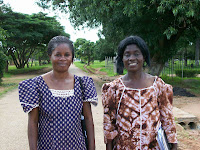 were spent – I sh*t you not – in total silence simply waiting for everyone to show up) to discuss whether to increase next year’s target goal for number of HIV treatment enrollees over this year’s, or leave it the same, only to then turn around and decide to actually decrease (!) it for some to-this-day-unknown-to-me reason, “this is the way things go here. And, truth be told, it is their program. Amy and I are technical advisors only. We can make suggestions, which we did, and ask leading questions, which we did, in an attempt to get them to think about things – like setting goals and creating new programs – in different ways, but we cannot think for them. We cannot decide for them.”
He’s right, I know. But this offends my very American sense of efficiency, of accomplishment. I mean, if I can get something done faster and better, why can’t I just go do it? Zambians, though, value consensus over efficiency, and relationships over accomplishments – even if that means making decisions that will set their program back a step. And for Zambia to triumph over HIV, Zambians have to lead the charge, however ineffectively. So you sit there, in helpless, tortured silence, and watch them do it, because allowing them this freedom is how you earn their respect. And you sit with the data entry clerk, for hour after constantly-interrupted hour, on a data validation task you know you could have completed in 15 minutes by yourself, because sitting with the data entry clerk for hour after constantly-interrupted hour is how you earn her trust.
This sitting-with-the-data-entry-clerk meant, of course, that most of my report developing was done at night, on my laptop, in to the wee hours of the morning. It was impossible to do it at the clinic, what with Dorica (the data entry clerk) constantly being pulled away to attend to one of the myriad tasks outside her job description but which, by necessity, she was required to perform. I’d stalk home at the end of the day (ok, so not visibly, but in my mind - I stalked) and mutter to Chris and Amy about “what a waste of time” the day was, “how much more I could have done” if I’d just worked at home and how “annoying” Dorica’s lack of focus was. “I know she wants me at the clinic with her,” I whined, “but it doesn’t really make sense for me to be there if she’s going to be hopping up and down the whole time. Not only can I not teach her anything, but I can’t get any of my work done either. All this stuff I’m trying to do is going to be a waste. I’m not going to end up being able to help her at all.” In other words: Wah. Wah, wah, wah, wah, wah.
And maybe that’s all true. Maybe if I’d had more hours to myself I could have built sleeker, more efficient reports instead of the clunky, this-is-what-we-have-to-do-to-work-around-CareWare’s-limits reports. But, truth be told, nobody expected that there’d be any reports finished before I left, least of all reports that Dorica could be trained to run on her own. But like everything else here, I’m learning, things have a way of working themselves out when you’re willing to let go.
So, on the Thursday night before we left – with reports still to complete and a full clinic day ahead of us on Friday, during which I knew Dorica would be unavailable for the three-hour training I’d developed for her – I let it go. We invited Ireen over for a lesson in making the traditional Zambian meal of nshima (it’s dreadful, but more on that some other time), fetched Dorica from the clinic, and spent our penultimate night in the company of our Zambian friends. And wouldn’t you know? I somehow managed to complete the final reports on Friday morning, load them on to Dorica’s machine and – miracle of miracles – spend the unexpectedly slow afternoon training her, with no interruptions, in her office at the clinic. And I got to see her not only get what I was teaching her (remember, Dorica was the one still grappling with the concept of “File, Save As…”), but reason through the complexities and light up when she discovered – on her own! – how the reports would make her work both easier and more accurate.
“Aiy!” she squealed, and clumsily high-fived me. Then her face clouded over. “You cannot go on Saturday,” she said. “You must remain behind when Chris and Amy proceed.”
“Ah, but I must go to Mukinge,” I tell her.
“Then you must leave your brain with me,” she says.
“Told ya,” Chris smart-alecked at dinner that night. “Things always work out. I have no idea how it happens or how to explain it. All I know is: you can plan, and plan, andplanandplan. You can do aaaall the planning you want, but you might as well not bother because nothing will ever go according to that plan. But I’m tellin’ ya - things always always works out.”
And that, my friends, is that.
Picture 1: Approaching rain cloud seen from the top of hill at Chilonga Mission
Picture 2: Dorica
Picture 3: Mrs. Banda (l) and Mrs. Phiri (r), midwives at the hospital
Picture 4: Dorica laughing at me making nshima
I had grand plans for the writing I was going to do here in Africa. I was going to record it all, every day, and just post entries whenever we happened upon an internet café or made our way back to Lusaka.
 But that was before I witnessed the peculiar paradox of starving women refusing to claim an errant 1,000 kwacha note that could buy them food for days; before the water quit working and then came back spluttering out of the faucets in muddy, tubercular bursts; before I learned just how glorious a meal is when you make it entirely with your own hands, from scratch (even the tortillas!); before the rains, the violent African rains, battered the swollen red earth and made a river of the road in front of our house; before I heard a funeral dirge, sung with vacant detachment by the village women, still manage to haunt and ring like the holiest of hallelujah choruses. Before the chickens and the dogs. Before Dorica. Before the stinging, bitter-smoke smell of sweat and sickness.
There’s just… it’s too much. Not to perseverate (by the way, totally my new favorite word) about the enormity of it all, but it really is overwhelming. There is too much to say and, so, nothing at all. Because, if you know me – as some of you do quite well – you know that if I can’t write it exactly, if I can’t write it perfectly, I usually don’t write it at all. So I sit, day after day, fingers hovering optimistically over my keyboard, and stare at a blank screen. There are stories to tell and observations to make – too many, in fact – but they seem silly without a context. And, well, I don’t mean to disappoint but, so far, the work (my work anyway) has not been particularly exciting. I’m not exactly saving lives or building schools or planting sustainable farms or anything like that. Don’t get me wrong – the work I am doing is rewarding (there are broader, if less tangible, programmatic implications for it), and I am, frankly, over the moon that I have a skill that can actually be utilized here (although the coronation to demigod and the attendant expectations that result when I am introduced as a – this is a good one - “computer expert” are a trifle unsettling). But it’s just, well, it’s just not very sexy.
Incidentally, the “work I am doing” has turned out to be a wee more complex than what we’d initially thought I’d be doing. In fact, it is essentially the same sort of work I was doing in Denver before I was a (ahem) “full-time actor”: poking around in large, relational databases and trying to extract data in meaningful ways so that it can be measured and analyzed. The short version of what that means at Chilonga is that I have had to figure out what questions to ask of their HIV patient tracking system (called CareWare) so that the reports I develop will answer them. Then, in order to actually build those reports, I’ve had to teach myself how to use the system, how to understand its basic architecture, and how to identify the relevant data
 variables. Finally, I have had to figure out how to train the data entry clerk – a delightful Zambian woman who, although she has an astonishing native intellect (particularly given her limited schooling) and a memory like a steel trap, is still trying to conceptualize “File, Save As…” – to run those reports herself. This all, of course, with no guidance from the folks who are purportedly requesting the data, no training on the CareWare software, and no access to the database developer or even a typically-useless-but-I’d-give-my-left-booby-for-one-right-now User Guide. And all in less than two weeks.
Suffice it to say I did not get much sleep the latter half of the Chilonga trip. I was up most nights until midnight, 1am, even 3am, writing and testing over 30 different reports (I’d have sacrificed my right booby for a SQL for Dummies book). I did catch a break when Herbie (remember Herbie? the current Chief of I-Forget-What-His-Title-Is-But-He’s-the-Big-Boss-In-Charge-of-Everyone-at-CRS? well, he’s also one of the former members of the FUTURES group, the company that originally built the database) passed by Chilonga on his way to another site early the second week and spent about 30-40 minutes giving me a crash course on CareWare’s basic reporting principles. Herbie, by the way, is a gigantically imposing, thickly-French-accented Haitian man and he kept saying things like: “Ok, so, dee CareWare ees not een-too-ah-teeve, so let me show you dees one ting how you can do dees”; and “Yes, ahk-choo-uh-lee, you haff to put dee dates in dee Ah-merry-can date format but nowhere ees dat written so you would not have known dat” (everything here is in the European dd/mm/yyyy format, including – confusingly enough – all of the date fields in the rest of the database); and “Ahk-choo-uh-lee, dee CareWare ees an Ah-merry-can program, and dey haff not fee-neeshed to making dee euh… dee euhm - ”
“The customizations?” I pipe in.
“Yes! Ouì!” he brightens. “Dee cost-om-eye-zay-shons! Dey haff not fee-neeshed to making dee cost-om-eye-zay-shons for dee African version.”
“Awesome,” I say, my task looming ever larger before me. My sarcasm is not lost on Herbie. He smiles apologetically, knowingly.
But Herbie, it turns out, is a godsend, and in our half hour together he shares a couple of tricks that were not, as he rightly maintained, even on the same planet as intuitive. But they are enough to get me started and so I am off. Er, well, sorta… Because this is Zambia and things never quite go the way you plan. In fact, if I had to name the biggest challenge I have faced thus far, it would not be the bugs or the water outages or the humidity or the physical hardship or the ripe, rank smells – these were the things I expected. In fact, I kind of counted on them. And they were, of course, everything and nothing like I imagined at the same time. No, if I had to name the biggest challenge we face (and all of us, by the way: Chris, Amy, me… IHV and the entire AIDSRelief team…), I think it would be learning to let go – to surrender whatever plans or expectations we have for the way things should or will go; and to be patient. Because even when you know (according to your plan) you can do something faster, or better, or more efficiently, or more effectively…you can’t. And not because you don’t want to. In fact, you are desperate to, because you know it would not only make your life easier but it would make theirs easier, too. You know how much more you could accomplish.
“But,” as my brother pointed out after one particularly maddening meeting during which a room full of medical professionals sat for more than an hour and a half (the first forty-five minutes
 were spent – I sh*t you not – in total silence simply waiting for everyone to show up) to discuss whether to increase next year’s target goal for number of HIV treatment enrollees over this year’s, or leave it the same, only to then turn around and decide to actually decrease (!) it for some to-this-day-unknown-to-me reason, “this is the way things go here. And, truth be told, it is their program. Amy and I are technical advisors only. We can make suggestions, which we did, and ask leading questions, which we did, in an attempt to get them to think about things – like setting goals and creating new programs – in different ways, but we cannot think for them. We cannot decide for them.”
He’s right, I know. But this offends my very American sense of efficiency, of accomplishment. I mean, if I can get something done faster and better, why can’t I just go do it? Zambians, though, value consensus over efficiency, and relationships over accomplishments – even if that means making decisions that will set their program back a step. And for Zambia to triumph over HIV, Zambians have to lead the charge, however ineffectively. So you sit there, in helpless, tortured silence, and watch them do it, because allowing them this freedom is how you earn their respect. And you sit with the data entry clerk, for hour after constantly-interrupted hour, on a data validation task you know you could have completed in 15 minutes by yourself, because sitting with the data entry clerk for hour after constantly-interrupted hour is how you earn her trust.
This sitting-with-the-data-entry-clerk meant, of course, that most of my report developing was done at night, on my laptop, in to the wee hours of the morning. It was impossible to do it at the clinic, what with Dorica (the data entry clerk) constantly being pulled away to attend to one of the myriad tasks outside her job description but which, by necessity, she was required to perform. I’d stalk home at the end of the day (ok, so not visibly, but in my mind - I stalked) and mutter to Chris and Amy about “what a waste of time” the day was, “how much more I could have done” if I’d just worked at home and how “annoying” Dorica’s lack of focus was. “I know she wants me at the clinic with her,” I whined, “but it doesn’t really make sense for me to be there if she’s going to be hopping up and down the whole time. Not only can I not teach her anything, but I can’t get any of my work done either. All this stuff I’m trying to do is going to be a waste. I’m not going to end up being able to help her at all.” In other words: Wah. Wah, wah, wah, wah, wah.
And maybe that’s all true. Maybe if I’d had more hours to myself I could have built sleeker, more efficient reports instead of the clunky, this-is-what-we-have-to-do-to-work-around-CareWare’s-limits reports. But, truth be told, nobody expected that there’d be any reports finished before I left, least of all reports that Dorica could be trained to run on her own. But like everything else here, I’m learning, things have a way of working themselves out when you’re willing to let go.
So, on the Thursday night before we left – with reports still to complete and a full clinic day ahead of us on Friday, during which I knew Dorica would be unavailable for the three-hour training I’d developed for her – I let it go. We invited Ireen over for a lesson in making the traditional Zambian meal of nshima (it’s dreadful, but more on that some other time), fetched
 Dorica from the clinic, and spent our penultimate night in the company of our Zambian friends. And wouldn’t you know? I somehow managed to complete the final reports on Friday morning, load them on to Dorica’s machine and – miracle of miracles – spend the unexpectedly slow afternoon training her, with no interruptions, in her office at the clinic. And I got to see her not only get what I was teaching her (remember, Dorica was the one still grappling with the concept of “File, Save As…”), but reason through the complexities and light up when she discovered – on her own! – how the reports would make her work both easier and more accurate.
“Aiy!” she squealed, and clumsily high-fived me. Then her face clouded over. “You cannot go on Saturday,” she said. “You must remain behind when Chris and Amy proceed.”
“Ah, but I must go to Mukinge,” I tell her.
“Then you must leave your brain with me,” she says.
“Told ya,” Chris smart-alecked at dinner that night. “Things always work out. I have no idea how it happens or how to explain it. All I know is: you can plan, and plan, andplanandplan. You can do aaaall the planning you want, but you might as well not bother because nothing will ever go according to that plan. But I’m tellin’ ya - things always always works out.”
And that, my friends, is that.
Picture 1: Approaching rain cloud seen from the top of hill at Chilonga Mission
Picture 2: Dorica
Picture 3: Mrs. Banda (l) and Mrs. Phiri (r), midwives at the hospital
Picture 4: Dorica laughing at me making nshima
“Just let me keep it” (Chilonga, Part I)
We have gone to the market, my brother and me, to retrieve my umbrella – one of the many personal belongings I seem to be shedding with alarming regularity since I arrived in Africa – from the shop where I’ve inadvertently left it on an earlier “bun run.” My umbrella, my fleece, my raincoat… I know I’m just being spacey – and I’d like to think I could come up with a more compelling and more permanent way than this anyway – but I think I must be desperate to leave my mark on this place, to be remembered. After only twelve days – many more by the time I will have a chance to post this – it has already begun to leave its mark on me.
But I am lucky. As with the raincoat (which I left behind in Dorica’s office late last week and got back from her today), the shopkeeper was glad to return my umbrella (my fleece – my Old Navy fleece which I got for $7 and which I loved and which would have come in handy during the unexpected cold snap in Chilonga – I fear is lost forever). Not that Dorica couldn’t use a raincoat, or the shopkeeper an umbrella. It is, after all, the rainy season, and Chilonga is in the Northern province (not, as I erroneously reported in an earlier post, in the Northeastern province – there’s actually no such province - though it is technically both north and east) and gets a boatload of rain. But this is not, from what I’ve observed, the way Zambians operate. So we cup our hands, one over the other like trapping a firefly, clap twice and, with a slight nod of our heads, express our thanks.
We have gone no further than fifteen feet when my brother spots a crisp, 1-pin note (1,000 kwacha) fluttering in the red dirt at his feet.
“Ah! Whose is this?” my brother asks the women in the market as he crouches to rescue it.
The women glance furtively around and shake their heads. “It is not mine,” they murmur, as much to each other as to us. They look away – none of them wants to be the one to admit their poverty, but hungry eyes and taught skin over sharp bones belie their feigned indifference. One thousand kwacha is equivalent to only 25 U.S. cents but, at this market, could buy someone a dozen tomatoes for nshima relish, or two buns, or a small sack of onions, or a heap of mangos. I am stunned at their reluctance to claim it.
“Is it yours?” my brother asks the small woman seated in front of the shop to our left. She shakes her head, chews her fingers. “Yours?” he says to the two women on our right. The Bemba, at least here at Chilonga, are not given to fits of laughter or grand expressions of mirth, but these women cackle and slap their knees, as if he is asking the world’s most ridiculous question.
“Not mine,” they say, waving him off, still chortling.
“Ah, but it is not mine so maybe it is one of yours?” he persists, looking from his left to his right. In truth, it probably is his (or mine), having doubtless escaped a loosely-zipped pocket on our earlier visit, because the people in these villages don’t often carry denominations of this size – they are used to dealing in 50 (roughly 1 cent) or 100 (2 cents) or 500 (you get the idea) kwacha notes – but we’d pretty much rather set ourselves on fire than flaunt our white privilege.
We stand for a moment, a now-familiar feeling of helplessness settling in. We know we can’t keep it; we know they won’t accept it. But we must wait – until the need becomes greater than the fear – because this is the way things work in Zambia: You wait. And wait and wait and wait.
By now a small crowd has gathered, and they watch us curiously. “Who will take it?” my brother asks. There is an uncomfortable, scratchy silence. I hang back, mirroring his pleading left-to-right looks – though with decidedly more desperation than he - and shift my weight. I feel my face flush with unexpected judgment. “Please, somebody, just take it!” I shout inside my head, as much to assuage the terrible ache of my own impotence as I would their palpable need. “It’s just a thousand kwacha!!”
But the rules of the game don’t allow this. And so the women continue to regard each other suspiciously, a double-dog dare flashing briefly in their faces. Who will confess their need? Who will flirt with (gasp!) greed?
“Who will take it?” my brother asks again, and there is movement to our right. All eyes go to the tall-ish, wrinkled bun-seller (one of at least two bun-sellers who, like the rest in this baffling and frankly ineffective model of commerce, sit right beside one another, in competition, selling the exact same buns for the exact same price) as she steps towards Chris, her left arm outstretched and beckoning vaguely, noncommittally, in his general direction.
“Ah,” she says with affected authority as she plucks the note from his fingers. “Just let me keep it.”
There is an eruption of laughter from the crowd – one of those atypical fits of grand expression – and a chorus of who-knows-what-they’re-actually-saying in Bemba that relieves the tension (mine especially) and paints the women in their shared judgment of the bun-seller’s scandalous lack of shame, their shock at her audacity, and their flapping, conspicuous envy.
Picture 1: Fish-seller at Mpika market
 personal belongings I seem to be shedding with alarming regularity since I arrived in Africa – from the shop where I’ve inadvertently left it on an earlier “bun run.” My umbrella, my fleece, my raincoat… I know I’m just being spacey – and I’d like to think I could come up with a more compelling and more permanent way than this anyway – but I think I must be desperate to leave my mark on this place, to be remembered. After only twelve days – many more by the time I will have a chance to post this – it has already begun to leave its mark on me.
But I am lucky. As with the raincoat (which I left behind in Dorica’s office late last week and got back from her today), the shopkeeper was glad to return my umbrella (my fleece – my Old Navy fleece which I got for $7 and which I loved and which would have come in handy during the unexpected cold snap in Chilonga – I fear is lost forever). Not that Dorica couldn’t use a raincoat, or the shopkeeper an umbrella. It is, after all, the rainy season, and Chilonga is in the Northern province (not, as I erroneously reported in an earlier post, in the Northeastern province – there’s actually no such province - though it is technically both north and east) and gets a boatload of rain. But this is not, from what I’ve observed, the way Zambians operate. So we cup our hands, one over the other like trapping a firefly, clap twice and, with a slight nod of our heads, express our thanks.
We have gone no further than fifteen feet when my brother spots a crisp, 1-pin note (1,000 kwacha) fluttering in the red dirt at his feet.
“Ah! Whose is this?” my brother asks the women in the market as he crouches to rescue it.
The women glance furtively around and shake their heads. “It is not mine,” they murmur, as much to each other as to us. They look away – none of them wants to be the one to admit their poverty, but hungry eyes and taught skin over sharp bones belie their feigned indifference. One thousand kwacha is equivalent to only 25 U.S. cents but, at this market, could buy someone a dozen tomatoes for nshima relish, or two buns, or a small sack of onions, or a heap of mangos. I am stunned at their reluctance to claim it.
“Is it yours?” my brother asks the small woman seated in front of the shop to our left. She shakes her head, chews her fingers. “Yours?” he says to the two women on our right. The Bemba, at least here at Chilonga, are not given to fits of laughter or grand expressions of mirth, but these women cackle and slap their knees, as if he is asking the world’s most ridiculous question.
“Not mine,” they say, waving him off, still chortling.
“Ah, but it is not mine so maybe it is one of yours?” he persists, looking from his left to his right. In truth, it probably is his (or mine), having doubtless escaped a loosely-zipped pocket on our earlier visit, because the people in these villages don’t often carry denominations of this size – they are used to dealing in 50 (roughly 1 cent) or 100 (2 cents) or 500 (you get the idea) kwacha notes – but we’d pretty much rather set ourselves on fire than flaunt our white privilege.
We stand for a moment, a now-familiar feeling of helplessness settling in. We know we can’t keep it; we know they won’t accept it. But we must wait – until the need becomes greater than the fear – because this is the way things work in Zambia: You wait. And wait and wait and wait.
By now a small crowd has gathered, and they watch us curiously. “Who will take it?” my brother asks. There is an uncomfortable, scratchy silence. I hang back, mirroring his pleading left-to-right looks – though with decidedly more desperation than he - and shift my weight. I feel my face flush with unexpected judgment. “Please, somebody, just take it!” I shout inside my head, as much to assuage the terrible ache of my own impotence as I would their palpable need. “It’s just a thousand kwacha!!”
But the rules of the game don’t allow this. And so the women continue to regard each other suspiciously, a double-dog dare flashing briefly in their faces. Who will confess their need? Who will flirt with (gasp!) greed?
“Who will take it?” my brother asks again, and there is movement to our right. All eyes go to the tall-ish, wrinkled bun-seller (one of at least two bun-sellers who, like the rest in this baffling and frankly ineffective model of commerce, sit right beside one another, in competition, selling the exact same buns for the exact same price) as she steps towards Chris, her left arm outstretched and beckoning vaguely, noncommittally, in his general direction.
“Ah,” she says with affected authority as she plucks the note from his fingers. “Just let me keep it.”
There is an eruption of laughter from the crowd – one of those atypical fits of grand expression – and a chorus of who-knows-what-they’re-actually-saying in Bemba that relieves the tension (mine especially) and paints the women in their shared judgment of the bun-seller’s scandalous lack of shame, their shock at her audacity, and their flapping, conspicuous envy.
Picture 1: Fish-seller at Mpika market
Saturday, January 6, 2007
Well, so much for recovering from jet lag
I can’t sleep. It’s – actually, I have no idea what time it is. For years now I’ve had this goofy rule where, once it gets past 11.30 or midnight wherever I am, I won’t look at a clock. I even turn my alarm clock away from me as I’m climbing in to bed every night just on the chance that at some point I’ll roll over and accidentally catch a glimpse of some ungodly hour flashing. I used to do that thing where I’d lie there twitching, my breath coming in long, determined sighs, calculating the hours I’d get if I fell asleep rightnow. But now, I don’t want to know how much sleep it is I’m not getting. I just want to pretend it’s as much as I need. I’m very serious about this. And very disciplined. So disciplined that even tho’ that little blinking digital clock in the bottom right-hand corner of my computer’s sys tray is rightnowatthisveryminute taunting me, daring me to take a peek, I am not looking at it. It could be 2.30 in the morning; it could be 4 - I have no idea.
I’m anxious, obviously. (Duh.) We went to the CRS (Catholic Relief Services) headquarters today so that I could meet some of the other folks with whom Chris and Amy and the rest of the IHV team work. They all knew who I was before I was even introduced. “Ah! Yes! You are Kay-tee,” they say, smiling warmly, shaking my hand with both of theirs. “You are Chris’s sister! We have been waiting for you.”
Waiting for me? No, that can’t be right. And yet it is. Seems word of my data analysis/database development experience has gotten around and not only does Chilonga have a job for me, but so does Mukinge. (They think they want me to build them a database. From scratch. In two weeks.) And after I come back, Herbie (the Chief of I-Forget-What-His-Title-Is-But-He’s-the-Big-Boss-In-Charge-of-Everyone-at-CRS) already has a plan for me. “You will go to Chilonga and then to Mukinge with Chris and Amy and then, after that,” he says authoritatively, “you will separate from them probably, yes? And you will help us with the monitoring and evaluations?” He smiles then. I think he must be laughing. I think it’s the look of abject terror on my face he finds so funny. “Yes. After that, you will separate from them and work here, maybe?”
Monitoring and evaluations (or M&E) is essentially the same as QA/QI work, or program evaluation, which (as I understand it) is measuring the efficacy or success of a program by analyzing data. It’s basically statistics. I sort of kind of have a limited, self-taught (read: huge-gaping-holes-in-my-knowledge-base) understanding of statistics from my time at the CU Foundation. Which, in Africa, of course means I’m an expert on the subject.
So that gnawing ache in my belly that’s keeping me from sleep tonight? Well, maybe it’s hunger (although I just went and made myself a sandwich which I think violates all the rules for overcoming jetlag because I probably – remember, I don’t look at the clock – was feeding myself right around East Coast dinner time), but I have a sneaking suspicion it’s this sudden fear of meeting the expectations that have been set for me. What if I’ve somehow misrepresented myself and the skills I have to offer? What if I can’t do what they’ve asked me? What if I not only can’t help them where they most need help but end up slowing down their work? What if, what if, what if…
I don’t know. And now I’m too tired to think much more about it. And it’s light outside now, which means it was probably closer to 4am when I started this than it was to 2. So I probably should try to get some sleep.
Thursday, January 4, 2007
I think I may have a future as a career criminal
Well, I’m here. Finally. After nearly five months of anticipation and 26 hours of travel on three  connecting flights over two days, we arrived in Lusaka around 8pm local time on Wednesday, January 3. I have to keep asking Chris and Amy what time it is, what day it is, because the last three have just sort of dissolved into one another. But we arrived in one piece, with all of our luggage, and – to our great astonishment – secured me a visitor’s visa good for three years, and all in less time than it takes ride the shuttle to concourse B at DIA. I should mention: Chris was here 8 months, as a resident and official employee of a governmentally-recognized relief organization, before securing his work permit. It’s now been over ten months, and Amy still hasn’t been granted hers (she’s on Chris’s as simply “wife” which, if you know Amy, is no small offense).
This is how things work in Africa, which is to say – sometimes they do and sometimes they don’t (but usually they don’t, I’m told). Maybe the immigration official was having a particularly good day that day. Or maybe they’ve changed the application process, or loosened the restrictions. Or maybe (insert conspiratorial nod here) it was the two crisp fifties I threw down. We’d heard from everyone that a visa (valid for 30 days) would cost $100, so – y’know - we just assumed.
So we got in line and when it came my turn and they asked me the purpose and length of my stay, we told them. “She must pay?” the agent said to my brother, who until this point was doing all my talking for me. She wasn’t really asking, but this is the way one makes a statement in Zambia.
“Oh! Right!” I say and hand her my $100.
She takes my money and, as she’s stamping my passport, says, “Ok. Three years.”
“Excuse me?” I ask, unsure of my ears. “I – three years?” I probe, over Chris and Amy’s murmured, sides-of-their-mouths pleas of “Take it! Just take it!”
“I give you three years visa,” she says again.
“I – um…ok,” I say uncertainly, taking my passport from her. I feel that strange mix of guilt and giddiness that comes with getting away with something you know you shouldn’t.
We round the corner to baggage claim and Chris and Amy are atwitter. “I don’t believe it!” Amy breathes. “That never happens!”
And my brother, shaking his head: “No. It really doesn’t.” And then: “Unless…” he says, theorizing. “Maybe it was the hundred bucks. Y’know, I never actually asked how much it costs. And she never said...” He shakes his head, waffles. “Nah, I’m sure it’s not -” (beat) “But, well, then again...” He shrugs. “Yeah, you might have just bribed your way in to Zambia, Kate.”
I am giddy and guilty all over again.
*****
I’m doing my best to soak it all up here – and by that I don’t just mean the humidity (did I mention it’s rainy season?), I mean the experience of this new, strange place I now inhabit – but it’s a trifle overwhelming. I want to take note of everything - every smell, every sound, every trick of this new, African light. But I have to keep reminding myself to be patient, that I don’t have to “get it” all today. Besides, I’m so frakkin’ pooped that everything just kind of blurs before me anyway. Literally. I’ve been struggling a bit with dizzy spells, doing that hips-low-feet-apart-to-keep-myself-from-swaying thing. And blinking. Like I’ve got a speck in my eye. Like maybe I can blink away the blur the way I do a fine piece of dust.
So far, though, this is what I’ve noticed: the glut of foot traffic on all of the roads, and the slow, purposeful walk of the thin-boned Africans; how much more at home Chris and Amy seem here than in America, even after only ten months; the way my drinking glass sweats – a fine, beady mist - the instant it’s filled (my drinking glasses never sweat in Colorado); the way my flippies fart on the rust-brown-colored parquet floors upstairs in the IHV house where we’re staying (it’s charcoal tile downstairs, but my flippies don’t fart downstairs); the ubiquitous uniformed guards at the gates of all the homes in the wealthy Lusaka neighborhood where the IHV house is; and the quiet, gentle way all Zambians seem to talk, so low you have to bend forward, shortening the distance between you - relinquishing the “personal space” we Americans covet so jealously - just to hear them. I feel awkward saying “what” and "excuse me" so many times; it seems impolite.
We went shopping today, for food for the weekend (we’ll shop again in a couple days for the food we’ll bring out to the bush). It was a little like being in an alternate universe, where the basic paradigm is the same (shopping center with a discount store, grocery store, cell phone store, coffee shop, etc…) but the details are different (instead of Target, it’s called Game; instead of Safeway it’s Spar or Shop-rite; instead of a Starbucks, there’s a Vasilis – or Vasillis, depending on which sign you read – Patisserie; instead of Verizon, it’s CellCity). Inside the Game store I felt like I did when I was at the dollar store I used to frequent in New Haven when I was in college. Not because of the prices (9 US dollars for a bottle of mouthwash??) but because you know how when you’re at the dollar store you know that what you’re looking at is still glass cleaner or a sponge or a bag of potato chips, but it’s not called Windex® or Scotch-Brite® or Lays®? It’s called, like, GlassoSpectaculo or Soak-‘Em-Ups or Chippy Crisps? It’s kind of like that. At Game (or at Spar or Shop-rite), you can still find many of the name brands familiar to us in America but, for the most part, it’s the Zambian (or, more accurately, South African – which is where most of what stocks the shelves comes from) version of soap or potato chips or orange juice that you see.
This, of course, is only in the city. In the bush, I imagine it will feel less like an “alternate” universe and more like a completely different world. We head out on Monday, incidentally. We go first to Chilonga, to the Chilonga Mission Hospital (also known as Our Lady’s Hospital), in the northwest province of Zambia; it’s about a seven-hour drive from Lusaka. We plan to be there about two weeks, which is about how long we plan to be at each of the bush hospitals we’ll be visiting for the first couple months we’re here. It’s still unclear exactly what it is we’ll be doing – Chris and Amy especially aren’t sure what each site will most need from them when they get there, but they figure they’ll be working in the clinics, evaluating the efficacy of the programs they helped to establish over the last year, and doing more teaching – but it looks like I may have my first assignment! Apparently, the folks at Chilonga have a new system for capturing patient data but as they’re still getting used to the idea of computers in general, they’re not sure how exactly this program works (or even how to do basic data entry). They’re hoping I’ll be able to make sense of it and then to train the user(s) in a way that allows them to maximize the use of it. Of course, this is all contingent on the hospital getting the computers, with the software installed, which we still haven't actually confirmed.
After Chilonga, it’s to Mukinge, which is on the opposite side of the country, in the Northeast province (a roughly 10-hour drive from Lusaka but about 15 from Chilonga). We have even less of an idea what we’ll be doing there, but Amy says it’s a site that employs many foreign nationals, so they’re accustomed to finding work for us. I may be cleaning out closets or organizing medical supplies in Mukinge, but – as with everything in Africa – we’ll figure it out when we get there.
 connecting flights over two days, we arrived in Lusaka around 8pm local time on Wednesday, January 3. I have to keep asking Chris and Amy what time it is, what day it is, because the last three have just sort of dissolved into one another. But we arrived in one piece, with all of our luggage, and – to our great astonishment – secured me a visitor’s visa good for three years, and all in less time than it takes ride the shuttle to concourse B at DIA. I should mention: Chris was here 8 months, as a resident and official employee of a governmentally-recognized relief organization, before securing his work permit. It’s now been over ten months, and Amy still hasn’t been granted hers (she’s on Chris’s as simply “wife” which, if you know Amy, is no small offense).
This is how things work in Africa, which is to say – sometimes they do and sometimes they don’t (but usually they don’t, I’m told). Maybe the immigration official was having a particularly good day that day. Or maybe they’ve changed the application process, or loosened the restrictions. Or maybe (insert conspiratorial nod here) it was the two crisp fifties I threw down. We’d heard from everyone that a visa (valid for 30 days) would cost $100, so – y’know - we just assumed.
So we got in line and when it came my turn and they asked me the purpose and length of my stay, we told them. “She must pay?” the agent said to my brother, who until this point was doing all my talking for me. She wasn’t really asking, but this is the way one makes a statement in Zambia.
“Oh! Right!” I say and hand her my $100.
She takes my money and, as she’s stamping my passport, says, “Ok. Three years.”
“Excuse me?” I ask, unsure of my ears. “I – three years?” I probe, over Chris and Amy’s murmured, sides-of-their-mouths pleas of “Take it! Just take it!”
“I give you three years visa,” she says again.
“I – um…ok,” I say uncertainly, taking my passport from her. I feel that strange mix of guilt and giddiness that comes with getting away with something you know you shouldn’t.
We round the corner to baggage claim and Chris and Amy are atwitter. “I don’t believe it!” Amy breathes. “That never happens!”
And my brother, shaking his head: “No. It really doesn’t.” And then: “Unless…” he says, theorizing. “Maybe it was the hundred bucks. Y’know, I never actually asked how much it costs. And she never said...” He shakes his head, waffles. “Nah, I’m sure it’s not -” (beat) “But, well, then again...” He shrugs. “Yeah, you might have just bribed your way in to Zambia, Kate.”
I am giddy and guilty all over again.
*****
I’m doing my best to soak it all up here – and by that I don’t just mean the humidity (did I
 mention it’s rainy season?), I mean the experience of this new, strange place I now inhabit – but it’s a trifle overwhelming. I want to take note of everything - every smell, every sound, every trick of this new, African light. But I have to keep reminding myself to be patient, that I don’t have to “get it” all today. Besides, I’m so frakkin’ pooped that everything just kind of blurs before me anyway. Literally. I’ve been struggling a bit with dizzy spells, doing that hips-low-feet-apart-to-keep-myself-from-swaying thing. And blinking. Like I’ve got a speck in my eye. Like maybe I can blink away the blur the way I do a fine piece of dust.
So far, though, this is what I’ve noticed: the glut of foot traffic on all of the roads, and the slow, purposeful walk of the thin-boned Africans; how much more at home Chris and Amy seem here than in America, even after only ten months; the way my drinking glass sweats – a fine, beady
 mist - the instant it’s filled (my drinking glasses never sweat in Colorado); the way my flippies fart on the rust-brown-colored parquet floors upstairs in the IHV house where we’re staying (it’s charcoal tile downstairs, but my flippies don’t fart downstairs); the ubiquitous uniformed guards at the gates of all the homes in the wealthy Lusaka neighborhood where the IHV house is; and the quiet, gentle way all Zambians seem to talk, so low you have to bend forward, shortening the distance between you - relinquishing the “personal space” we Americans covet so jealously - just to hear them. I feel awkward saying “what” and "excuse me" so many times; it seems impolite.
We went shopping today, for food for the weekend (we’ll shop again in a couple days for the food we’ll bring out to the bush). It was a little like being in an alternate universe, where the basic paradigm is the same (shopping center with a discount store, grocery store, cell phone store, coffee shop, etc…) but the details are different (instead of Target, it’s called Game; instead of Safeway it’s Spar or Shop-rite; instead of a Starbucks, there’s a Vasilis – or Vasillis, depending on which sign you read – Patisserie; instead of Verizon, it’s CellCity). Inside the Game store I felt like I did when I was at the dollar store I used to frequent in New Haven when I was in college. Not because of the prices (9 US dollars for a bottle of mouthwash??) but because you know how when you’re at the dollar store you know that what you’re looking at is still glass cleaner or a sponge or a bag of potato chips, but it’s not called Windex® or Scotch-Brite® or Lays®? It’s called, like, GlassoSpectaculo or Soak-‘Em-Ups or Chippy Crisps? It’s kind of like that. At Game (or at Spar or Shop-rite), you can still find many of the name brands familiar to us in America but, for the most part, it’s the Zambian (or, more accurately, South African – which is where most of what stocks the shelves comes from) version of soap or potato chips or orange juice that you see.
This, of course, is only in the city. In the bush, I imagine it will feel less like an “alternate” universe and more like a completely different world. We head out on Monday, incidentally. We go first to Chilonga, to the Chilonga Mission Hospital (also known as Our Lady’s Hospital), in the northwest province of Zambia; it’s about a seven-hour drive from Lusaka. We plan to be there about two weeks, which is about how long we plan to be at each of the bush hospitals we’ll be visiting for the first couple months we’re here. It’s still unclear exactly what it is we’ll be doing – Chris and Amy especially aren’t sure what each site will most need from them when they get there, but they figure they’ll be working in the clinics, evaluating the efficacy of the programs they helped to establish over the last year, and doing more teaching – but it looks like I may have my first assignment! Apparently, the folks at Chilonga have a new system for capturing patient data but as they’re still getting used to the idea of computers in general, they’re not sure how exactly this program works (or even how to do basic data entry). They’re hoping I’ll be able to make sense of it and then to train the user(s) in a way that allows them to maximize the use of it. Of course, this is all contingent on the hospital getting the computers, with the software installed, which we still haven't actually confirmed.
After Chilonga, it’s to Mukinge, which is on the opposite side of the country, in the
 Northeast province (a roughly 10-hour drive from Lusaka but about 15 from Chilonga). We have even less of an idea what we’ll be doing there, but Amy says it’s a site that employs many foreign nationals, so they’re accustomed to finding work for us. I may be cleaning out closets or organizing medical supplies in Mukinge, but – as with everything in Africa – we’ll figure it out when we get there.
Until then, I’ll be doing my best to recover from jet lag and take note of all that’s new around me. We won’t have any internet access in the bush, so unless I write again before we go, this maybe my last post for a while.
Picture 1: The driveway in to the complex where the IHV house is
Picture 2: Outside the IHV house
Picture 3: Foot traffic on Bishop Road, the nearest cross street to Sable, the road on which we live
Picture 4: Behind a lorry on Great North Road, heading out of the city
Tuesday, January 2, 2007
“Well. You’re gonna wanna rethink your shoe wardrobe.”
This was my brother’s advice when I first asked him what I should do to prepare for my impending six-month sojourn to Africa. Not that there’s all that much one can say that could actually “prepare” one for Africa, but I confess I was expecting something more along the lines of, say, a discourse on the geo-political ramifications of the tribal social construct and the attendant challenges facing white, middle-class Americans as they work to stem the tide of the African AIDS pandemic. After all, this has been his work for the last almost-year and, well, he went to Dartmouth.
But I’m sitting in my parents’ living room in Massachusetts, where I’ve spent the last nearly two weeks with my family, and though it’s been months since that conversation - and we’ve by now talked about more than just replacing my Manolos with Merrells (yeah, like I really have Manolo’s…or Merrells) - the fact that I’m leaving for Africa tomorrow - and for six months! – still hasn’t really sunk in.
For starters, it’s cold as f**k here. Not that we don’t get cold in Colorado. But Colorado cold is bright, sharp, quick; it stings and sets you in motion. Massachusetts cold is much more insidious. It’s damp and heavy and settles in your bones so permanently that even when it’s warm – as it actually was for a few days here – it still feels cold. This is not weather conducive to managing fibromyalgia - that goofy, annoying pain disorder I live with that some of you have heard me talk about (and look! now you know how to spell it!). I haven’t slept the night through since I got here twelve days ago and I ache from the top of my head to the tips of my toes; the joints in my shoulders and hips swell, my knees stiffen, my skin even hurts. I always forget how hard it is to come back here. I mean, there’s always the challenge of returning to your childhood home no longer a child and having to relate to your family (your-family-that-you-love-and-cherish-more-than-frigging-life-itself-and-for-whom-you-would-lie-down-in-traffic-just-watch-me-but-that-every-now-and-then-you-wonder-if-you-could-trade-in-but-only-for-a-little-while-i-swear) as the familiar strangers you now are. But the weather, man! Jeeminy Christmas! It will be worse in Africa, I’m sure. But at least – I tell myself – at least there it will be warm.
Anyhoo, so off I go to Africa. Tomorrow. (or, y’know, last week by the time most of you read this). And it still doesn’t seem real. I’ve gotten all of my shots, sublet my apartment, and purchased and packed my six-month supply of tampons (oh you laugh…), but I still can’t say that I feel ready. I never watched the films my brother ended up suggesting or made it through any of the books (although I am now finally reading Alexandra Fuller’s Don’t Let’s Go to the Dogs Tonight and it’s friggin’ brilliant). But, shortly before I left Colorado, I did have a minor panic attack where I started to worry that IHV was going to administer some kind of entrance exam before they let me de-plane, so I printed off the MSN Encarta online encyclopedic entry for Zambia and did a little cramming: Location: South Central Africa; Capital City: Lusaka; Official Language: English (though collectively there are more than 70 African languages spoken); Currency: the kwacha; Government: Republic, with an elected president limited to two five-year terms; Climate: “Ummm…kind of like Colorado… (beat) Uh…I think,” I told someone in an exhausted delirium a couple days before I left (and then nodded my head vigorously in an attempt to demonstrate my authority on the subject). “Kind of like Colorado…?!” While I had a vague recollection of a cursory mention of high elevation in the Encarta entry (most of Zambia is high plateau with elevations between 3,500 and 4,500 feet), I was - clearly - talking out my ass. (Incidentally, the climate - for those of you interested - is considered “pleasantly subtropical.” The high elevation moderates the otherwise more extreme temperatures endured by other parts of sub-Saharan Africa. Chris and Amy said the temperature hovered pretty consistently at 95-105 degrees in October and November - even at night - which they say are generally the hottest months; but Encarta claims January is the hottest month, so who knows what I should expect when I get there – oh, except rain. November to April is the rainy season, so there’ll definitely be a lot of rain).
I’ve been asked more than a few times if I’m scared. My answer, of course, is “Um, have you met me?” I’m terrified. But not of Africa. I don’t know enough to be scared of Africa. Outside of those few superficial facts detailed above (the currency, the climate, the capital city…), it remains a complete, dark mystery to me. Neither have I any clue what it is I’ll be doing when I get there (hopping from bush hospital to bush hospital with Chris and Amy? working for IHV in Lusaka as the in-country admin? training the office administrator in Malawi? some combination of the above?). Accordingly, I have no idea what it is I should fear. Sure, I worry a little about getting sick; and I worry a lot about violating social mores and inadvertently offending the people (and, consequently, embarrassing my brother and IHV). But most of what I fear has nothing to do with Africa and everything to do with me - I worry about the community I’m leaving behind, what I’ll miss out on by going, whether or not I’ll even be missed. And my biggest fear of all? My biggest fear is that I’ll return in six months (or seven, or however long I end up staying) unchanged. So, of course, I’ve tried to anticipate the ways in which I will – or at least hope to.
“Ah, don’t do that to yourself!” my friend Tory told me. “You’ll go, and it will change you – how can it not? – but never in the ways you’d imagine. And more than likely in ways you won’t see for months or even years after you come back. So don’t put that kind of pressure on yourself.” I laughed, then. Because Tory’s a new friend. He has no idea yet the kind of pressure I can put on myself.
It sounds silly, I’m sure. It is impossible to know what to expect and therefore impossible to plan for it. But I’ve never been good at operating without a plan. I’ve never been comfortable making choices or taking action where the outcome is unknown. Historically, I’ve been what they call in the investment industry “risk averse” - I may dream big, but I often “do” small (or at least safe); more often I don’t do at all – I get paralyzed by indecision, by my fear of the unknown. I try to anticipate the outcome and usually can’t so I remain stuck. But, like my good, noble, kind, wise dad always says, “You gotta sh*t or get off the pot.”
So, tomorrow (in a few scant hours, actually) when I board the plane for Africa, I will – metaphorically speaking – for once in my life, "get off the pot." I can't promise that I'll be diligent about it, but I hope to document as much as I can using this web page. Please feel free to leave comments here or email me directly. And keep me in your thoughts. I may think I don't know enough to be scared about anything in Africa, but I'm sure by day three I'll be curled in a fetal ball begging Chris and Amy to send me home!
Subscribe to:
Posts (Atom)
